
A long wait for hot water can make an ordinary shower feel slow, especially in a busy household where several people need the tap at once. Under sink recirculating pumps move already-heated water through the household line, while related sensor valves and timers can control when that circulation happens. These systems suit homeowners dealing with long pipe runs, tank water heaters, and recurring cold-water waits.
The Lineup, Simplified

TRUPOW 3/4 NPT 3-Speed Circulation Pump

AB 110V 3-Speed Hot Water Pump

Tpcy-c WP596816 Sensor Valve Kit
Tpcy-c Recirculating Pump Kit with Timer

Tpcy-c 595926 Thermal Bypass Sensor Valve

Talspity UP15-10SU7P/TLC Circulator Pump
A. O. Smith APCOM UT1 Under Sink Pump

Grundfos GRU-595916 25-Watt Recirculation Kit
Meet The Standout Selections
The TRUPOW pump gives you three output levels, which makes it more adaptable than a single-speed circulator. Its 3/4-inch NPT connection suits a broad range of household hot-water piping, although you’ll need to confirm that your existing fittings and layout can accept the pump without crowding the service area.
For a home with a long pipe run or several fixtures that need warm water, the adjustable flow can help balance delivery against operating power. Compared with the 25-watt Grundfos GRU-595916, this model offers more speed control, but it also demands more space and closer attention to hydraulic, or water-flow, requirements.
Useful Touches
- Three power settings let you tune circulation for different household demand.
- Maximum flow reaches 30 liters per minute for handling larger hot-water loops.
- A cast iron body and aluminum housing suit pressure-based hydronic installations.
- Ceramic shaft and copper motor wiring provide useful material detail for system planning.
Trade Offs
- Its 100-watt top speed uses more electricity than a low-power domestic circulator.
- Installation requires a matching 3/4-inch NPT connection and adequate clearance.
Key Specs
Right Fit
This pump suits homeowners with a larger recirculation loop, a 110-120-volt supply, and room for a three-speed circulation unit beside the tank or manifold.
Another Choice May Suit
The Grundfos GRU-595916 fits smaller pipe runs where low power, a compact body, and a six-foot power cord matter more than adjustable output.
The AB pump brings together a 13 GPM maximum flow, cast iron construction, and three manually selected speeds in one 110-volt circulator. GPM means gallons per minute, a flow measure that helps you compare the pump with the demands of your household plumbing and hydronic, or liquid-heating, loop.
That makes it a practical option for a larger recirculation setup or a home using the pump for floor heating, boiler, or solar-water circulation. The TRUPOW model reaches 30 liters per minute, while the AB reaches roughly 49 liters per minute, so your decision comes down to the pipe system’s required capacity rather than the product label alone.
Strengths Worth Knowing
- Three speeds provide 55, 90, and 130-watt operating options.
- Included flanges, gaskets, nuts, and bolts reduce extra fitting purchases.
- Cast iron and a PES impeller suit demanding hot-water circulation.
- The 24-foot maximum head gives it useful reach in larger loops.
Practical Considerations
- The pump supports up to 145 psi and 230°F, making system limits essential to verify.
- Its red housing and larger housing need adequate cabinet or service-space clearance.
Feature Snapshot
Built With In Mind
This model fits homeowners with a 110-volt electrical supply, a higher-capacity hot-water loop, and enough installation space for a cast iron pump and flanged connections.
Reach For A Different Pick When
The TRUPOW 3/4 NPT 3-Speed Circulation Pump is the better fit for a more compact installation using threaded NPT plumbing instead of flanged connections.
The WP596816 is a sensor valve rather than a pump, so it belongs in a different part of the decision. It adds temperature-responsive control to a compatible recirculation system, opening as water cools and closing once the water reaches 98°F. That automatic behavior suits a household that already has a circulation pump but lacks a working thermal bypass assembly.
The included supply lines and reducing fittings make the package more practical for a repair or retrofit. You still need to confirm the pipe arrangement, model numbers, and physical space before ordering, since the valve won’t replace the circulator itself.
What Stands Out
- Automatic opening and closing responds to the water temperature.
- A copper body and electroplated exterior suit a hot-water installation.
- Two 12-inch lines reduce the need to source separate supply tubing.
- The included reducers connect 1/2-inch female threads to 3/8-inch male threads.
Worth Noting
- Compatibility centers on specified 500800, 500805, 307010, and 595926 systems.
- This is a component, not a complete under-sink circulation package.
Made For
This kit fits a homeowner repairing a listed recirculation system and needing an automatic sensor valve, two supply lines, reducers, and mounting screws.
Look Elsewhere When
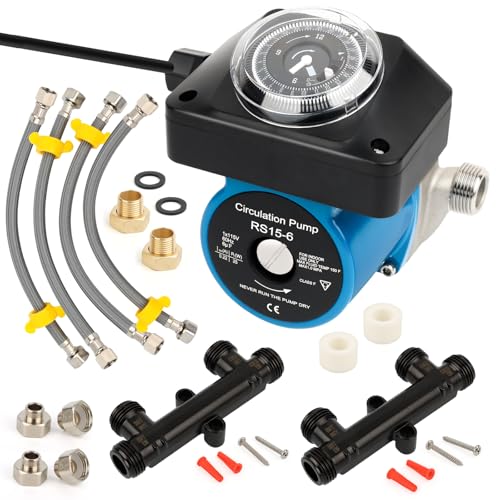
The Tpcy-c Recirculating Pump Kit with Timer is the better choice for a new tank-heater installation that needs a pump, timer, and two bypass valves together.
A programmable timer can make recirculation more deliberate than running a pump continuously. This kit pairs that control with a pump and two brass bypass sensor valves in a four-line configuration, giving you a coordinated starting point for a tank water-heater system.
The practical appeal is scheduling. Morning and evening hot-water demand can be covered without keeping circulation active around the clock, while the paired valves help manage water moving between the heater and household lines. Installation still deserves careful planning because the four-line arrangement must suit your pipe layout.
Good Reasons To Consider
- The programmable timer supports scheduled morning and evening operation.
- Two brass bypass sensor valves are included in the package.
- A four-line configuration is designed for tank water-heater systems.
- Combining the components can simplify parts gathering for a new installation.
Things To Consider
- The four-line setup needs to align with your existing plumbing configuration.
- The timer reduces unnecessary circulation, but it cannot replace a correctly sized pump for the full system load.
Quick Facts
Who It Suits Best
This package suits a DIY-minded homeowner or plumber building a scheduled recirculation arrangement around a compatible tank water heater.
Where Another Pick Suits Better
The A. O. Smith APCOM UT1 Under Sink Pump better fits a compact under-sink installation that relies on built-in thermostat and timer controls.
The 595926 thermal bypass valve is built around a simple operating principle: it opens when the returning water cools and closes again at 98°F. A thermal bypass is the valve path that manages hot water within a recirculation circuit, so this part plays a central role in how your system responds.
Compared with the WP596816 sensor-valve kit, this option focuses on a single 595926-style component and highlights precision-machined threaded connections. It may suit a professional installation or a targeted replacement, while the WP596816 package is more convenient for a repair that also needs two 12-inch lines and reducing fittings.
Practical Pluses
- Temperature-triggered operation removes the need for a continuously open bypass.
- Copper construction and black electroplating suit the hot-water environment.
- Machined brass threads support a secure, properly aligned connection.
- Compatibility extends across several named Comfort series models.
Points To Keep In Mind
- Model compatibility must be confirmed before the valve is ordered.
- You’ll need the surrounding pipework and circulation pump to complete the system.
Best Suited To
This valve fits a plumber or experienced homeowner installing or replacing a temperature-controlled bypass in a listed recirculation system.
Swap It Out When
The Tpcy-c WP596816 Sensor Valve Kit is the better fit when your installation also needs two 12-inch supply lines and reducing fittings.
The Talspity UP15-10SU7P/TLC is mainly a replacement choice, not a general shopping starting point. It directly matches the Grundfos UP15-10SU7P/TLC naming and is also listed for part numbers 59896288P1 and 595916. That specificity helps you avoid purchasing a pump whose dimensions or electrical arrangement may not match the original.
Its 25-watt motor and 6.5 GPM capacity suit a smaller recirculation loop, while the 1.5-meter maximum head defines how much vertical lift it can provide. In a basement utility area, that low electrical demand can be attractive, but matching the replacement model remains the central decision.
Everyday Wins
- Low 25-watt operation suits compact domestic recirculation loops.
- A 3/4-inch connection matches common replacement-pump plumbing.
- The UP15-10SU7P/TLC model reference simplifies replacement selection.
- An IP44 rating provides a stated level of protection against water ingress.
Small Caveats
- The listed 1.5-meter head is lower than the TRUPOW model’s 6-meter maximum.
- You should match the original pump’s electrical setup, connection, and mounting arrangement.
Technical Highlights
Made For
This pump fits a homeowner replacing a specifically listed UP15, 59896288P1, or 595916 circulator in a compact residential loop.
A Better Fit Elsewhere
The Grundfos GRU-595916 Recirculation Kit is the better choice for a new system needing a timer, six-foot cord, and broader flow range.
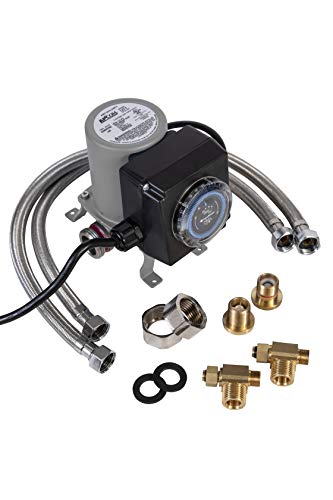
The APCOM UT1 is designed specifically for the space beneath a sink, making its placement part of the product’s purpose rather than an afterthought. It is intended for tank-type water heaters and uses a built-in thermostat and timer to control circulation automatically. That arrangement suits households seeking a compact system for a basin cabinet that already has access to power and plumbing.
The trade-off is less visible control than a programmable kit with a separate timer. Compared with the Tpcy-c Recirculating Pump Kit with Timer, the APCOM UT1 has a more integrated under-sink design, while that alternative offers a four-line arrangement and externally scheduled operation.
Where It Helps
- Built-in thermostat and timer provide automatic circulation control.
- The under-sink format suits a compact basin-cabinet installation.
- Automatic operation reduces the need for daily switching at the pump.
- The design targets tank-type water-heater households.
Details To Watch
- Your tank heater and under-sink space need compatible plumbing arrangements.
- A built-in timer may offer less schedule flexibility than a programmable external timer.
Right Fit
This unit suits a homeowner with a tank water heater who wants automatic hot-water circulation installed beneath the kitchen sink.
Consider Something Else When
The Tpcy-c Recirculating Pump Kit with Timer better fits a household that needs two bypass valves and a separately programmable schedule.
The Grundfos GRU-595916 combines a 25-watt circulator with timer controls and a six-foot line cord, making it a practical package for a small household loop. Its 0-to-9 GPM flow range gives you room to adjust movement through the system, while the 6-foot maximum head suits pipe layouts with modest vertical rise.
Unlike the under-sink-focused APCOM UT1, this is a general circulator kit with 3/4-inch male and female NPT connections. That makes it useful in a broader hydronic arrangement, provided your pump location allows access to power and the pipe layout can accept the specified connections.
A Few Strong Suits
- Low 25-watt consumption suits compact circulation demands.
- The timer and six-foot cord simplify a scheduled installation.
- A 0-to-9 GPM range offers meaningful adjustment within the system.
- Quiet running suits utility rooms and occupied living spaces.
Possible Compromises
- The six-foot cord may not reach a nearby outlet without an extension or different placement.
- The six-foot maximum head is lower than the TRUPOW pump’s rated reach.
At A Glance
Who Will Love This
This kit fits a homeowner with a compact hydronic loop who values timed operation, quiet running, and a straightforward 3/4-inch connection.
Skip It When
The AB 110V 3-Speed Hot Water Pump is the better option for a larger circuit needing greater flow and flange-style fittings.
What Matters Before You Choose a Recirculation System
Match the pump to the plumbing
Start with the connection size and the distance your pump must move water. NPT is a threaded pipe standard, while flanged systems require matching flanges and gaskets. The pump also needs enough head, meaning vertical lift, to reach the intended fixture.
Check the household demand
A larger household or a long pipe run may benefit from a higher-flow, adjustable-speed model. Smaller loops can often be handled by a compact 25-watt circulator. Your existing pipe diameter, water-heater arrangement, and number of distant fixtures all affect that choice.
Decide how control should work
A built-in timer offers a compact arrangement, while a programmable timer lets you schedule circulation around mornings and evenings. A temperature-controlled sensor valve adds another layer by responding to cooled water. Your preferred schedule and plumbing access should guide the selection.
Plan the installation space
Under-sink systems need cabinet space, nearby electrical service, and accessible connections. A replacement pump must match the original model, electrical arrangement, and mounting position. For complicated pipework or tank-heater connections, a professional plumber can help verify compatibility before installation.
Common Mistakes in Recirculation Setup
Mistakes Worth Dodging
A frequent error is focusing on flow rate while overlooking connection type and available head. Another is treating a replacement pump as a universal model. Check model numbers, mounting space, electrical supply, and pipe dimensions before ordering.
When Paying More Pays Off
Higher-powered or more adjustable models can be worthwhile for larger loops, multiple fixtures, or higher head requirements. For a compact household circuit, extra power may add little, so a timed 25-watt circulator can be the more sensible choice.
Frequently Asked Questions
Can an under sink recirculation pump work with a tank water heater?
Yes, a recirculation pump can move heated water from a compatible tank water heater through the household supply lines. The pump, valve arrangement, pipe connections, and heater must form a compatible system.
Do you need a recirculation pump for every home?
No. Recirculation is most useful when a long pipe run causes a noticeable delay at the tap or shower. Short routes and favorable plumbing layouts may need less help.
What is the difference between a circulation pump and a sensor valve?
A circulation pump moves water through the loop, while a sensor valve controls the bypass path according to water temperature. Some complete systems combine both functions.
How many watts should an under sink hot water pump use?
The suitable wattage depends on flow, head, pipe layout, and heating demand. Compact loops may operate effectively with a 25-watt pump, while larger systems may need more adjustable power.
Are replacement pumps universal?
Replacement pumps are rarely universal. Match the model number, connection size, voltage, mounting arrangement, and required flow before replacing an existing circulator.
Final Verdict
Your best fit depends on the plumbing rather than the label alone. Choose a three-speed pump for adjustable output, the APCOM UT1 for a compact under-sink arrangement, or a timed kit for scheduled circulation, then verify every connection before ordering. A careful compatibility check is the difference between a smooth installation and a mismatched system.