
A heavy sliding gate at the end of a long driveway creates two connected problems: moving it reliably and keeping it powered where wiring is inconvenient. I focused on gate weight, drive system, remote range, solar capability, backup power, and safety controls, since these details determine whether an opener suits a busy home, a farm entrance, or a rental property.
The lineup includes three solar-capable openers, two wired alternatives, and one remote-control accessory. That mix reflects the practical decision many property owners face: an off-grid installation, a conventional electrical setup, or a replacement control for an existing system.
A Quick View Of The Lineup

TOPENS DKC1100S Solar Opener

Blütezeit 1800lb Automatic Sliding Gate Opener Rack-Drive Kit

PalaUha 1300lb Automatic Sliding Gate Opener Kit with 2 Remotes
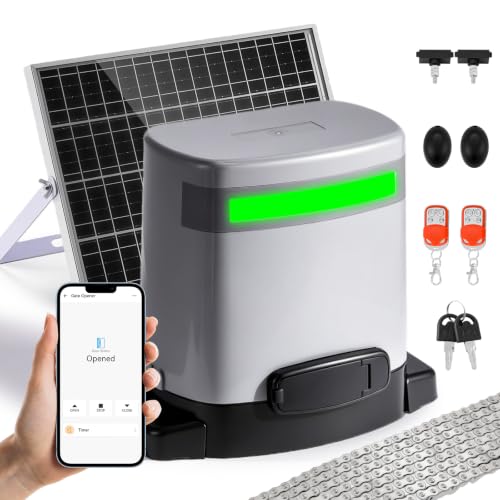
Spolehli 1300lb Solar Chain-Drive Sliding Gate Opener Kit

Vimke 1800lb Solar Chain-Drive Gate Opener with 20W Panel

Colorpp Sliding Gate Opener Remote Control Kit
A Closer Look At Each Pick
A gate rated for 2,600 pounds changes the installation calculation, and the TOPENS DKC1100S is built around that kind of load. Its solar chain-drive format gives it the capacity and off-grid flexibility associated with heavier residential gates.
The chain drive transfers motor force through a chain-and-sprocket assembly, making it suited to long sliding gates. Compared with the 1,300-pound options later in the lineup, this model offers more headroom, although its installation footprint and solar placement need careful planning.
Real-World Strengths
- Supports gates up to 2,600 pounds.
- Handles sliding gates up to 40 feet long.
- Uses a 450-watt DC motor for demanding gate movement.
- Solar operation reduces dependence on nearby wiring.
- Chain drive suits long, heavy sliding sections.
Practical Considerations
- The stated capacity and length still require comparison with the actual gate weight, track, and slope.
- Solar performance depends on panel placement and local sunlight exposure.
Key Specs
Built With In Mind
Property owners with long, heavy gates and limited access to mains power gain the most from this configuration.
A Better Fit Elsewhere
The Blütezeit 1800lb Automatic Sliding Gate Opener Rack-Drive Kit fits lighter wired gates where quiet rack-driven operation matters.
A wired rack drive makes more sense where electrical service is already available close to the track. This Blütezeit model uses a 370-watt motor and combines an 1,800-pound capacity with a stated operating level of 45 dB or less.
A rack drive uses a toothed gear to move the gate, and this package includes galvanized steel rack sections. It contrasts with the TOPENS DKC1100S by favoring a wired, quieter arrangement instead of solar power and the greater 2,600-pound load rating.
Bright Spots
- Rated for gates up to 1,800 pounds.
- Quiet operation suits close-to-home entrances.
- Infrared sensors help stop the gate from closing on an obstruction.
- Manual release provides access during power loss.
Worth Noting
- AC 110-volt power requires a suitable electrical connection.
- The stated 40-foot gate length needs confirmation against the track and rack layout.
- Stop-and-reverse behavior depends on proper sensor alignment.
Feature Snapshot
Who It Suits Best
Homeowners and small businesses with wired access and noise-sensitive gates benefit most from this rack-driven setup.
Where Another Pick Suits Better
The Spolehli 1300lb Solar Chain-Drive Sliding Gate Opener Kit suits an off-grid property that needs app-based control.
Long remote range and programmable closing make this PalaUha kit convenient for a driveway where a vehicle approaches from beyond the keypad or wall. Its two remotes reach up to 164 feet, and the operator can close after 5, 10, or 20 seconds.
That remote-focused feature set distinguishes it from the Blütezeit’s emphasis on quiet rack operation. The trade-off is a 370-watt AC 110-volt motor rated for a lighter 1,300-pound gate, with no solar capability.
Where It Excels
- Two remotes support convenient vehicle entry.
- Remote range extends up to 164 feet.
- Three programmed closing intervals reduce manual gate closing.
- IP44 protection helps resist rain and dust.
- A mechanical key enables manual operation during an outage.
Where It May Fall Short
- Its 1,300-pound rating is below the TOPENS and Blütezeit models.
- AC wiring is required for normal operation.
- Infrared sensors need a clear, correctly aligned beam across the opening.
The Right Fit
Shoppers seeking a straightforward wired opener with long remotes and delayed closing benefit from this focused package.
Consider Something Else When
The Vimke 1800lb Solar Chain-Drive Gate Opener with 20W Panel suits a heavier gate requiring solar power and several access methods.
Controlling a gate from a phone becomes practical when the property lacks a convenient electrical connection. The Spolehli combines solar power, a chain drive, Wi-Fi control through the eWeLink app, and two remotes with a stated 165-foot range.
Its 1,300-pound rating matches the PalaUha model, but the solar panel and backup battery create a more flexible installation. Compared with the Vimke, it has a lighter stated capacity and a smaller 20-watt solar panel, although the Vimke adds a keypad and a larger battery.
A Few Highlights
- Solar operation supports an off-grid installation.
- Wi-Fi app control adds remote access beyond handheld remotes.
- Two remotes reach up to 165 feet.
- A built-in battery provides backup power.
- Anti-collision sensing responds to contact with an obstruction.
Details To Watch
- The gate must remain within the 1,300-pound rating.
- Solar placement depends on unobstructed sunlight.
- App access depends on a functioning Wi-Fi connection.
At A Glance
Who Will Love This
Connected-property owners with a light sliding gate and limited wiring access gain the most from this solar and app-controlled setup.
Another Choice May Suit
The TOPENS DKC1100S Solar Opener suits households whose gate exceeds 1,300 pounds and need greater drive capacity.
The Vimke combines a 1,800-pound rating with a 20-watt solar panel and a 24-volt, 6-amp-hour battery. That battery can provide up to five days of operation without an external source, making the kit relevant to properties where uninterrupted access carries more weight than a simple remote-only setup.
Wi-Fi app, keypad, and remote controls cover several entry habits. Compared with the Spolehli, this model supports a heavier gate and a larger stated battery, but the TOPENS DKC1100S still leads on the stated 2,600-pound capacity.
Practical Pluses
- Supports gates up to 1,800 pounds.
- 20-watt solar panel supports off-grid charging.
- Backup battery offers up to five days of operation.
- App, keypad, and remote controls provide flexible access.
- The 280-watt motor moves the gate at up to 40 feet per minute.
- An infrared sensor assists with obstruction detection.
Trade Offs
- The 20-watt panel needs suitable sunlight and correct orientation.
- Motor testing requires a solar or AC 110-volt source.
- The multi-control setup adds more components to install and configure.
Made For
Rural properties and long driveways needing solar charging, battery backup, and keypad access fit this package well.
Reach For A Different Pick When
The Colourpp Sliding Gate Opener Remote Control Kit suits an existing opener that needs replacement handheld controls.
A missing handheld control can leave a functioning gate inaccessible from a vehicle, and the Colorpp kit addresses that narrower problem. It provides a 433.92-megahertz fixed-frequency remote and two backup keys for an existing sliding-gate operator.
This is an accessory rather than a complete opener or solar installation. Its stated 50-to-100-meter range and ability to copy common fixed codes make it relevant for replacing or supplementing compatible remotes, but the existing opener’s frequency and coding method must match.
What Works In Its Favor
- Two backup keys support shared access.
- Radio-frequency control avoids a separate wall keypad.
- Stated range reaches 50 to 100 meters.
- Fixed-code copying can reproduce common compatible controls.
Small Caveats
- The kit does not include a motor, solar panel, or complete gate operator.
- Compatibility depends on the original opener using a supported 433.92-megahertz fixed code.
- Existing remotes and the new control should be programmed together before old units are discarded.
Quick Facts
Best Suited To
Owners of compatible fixed-frequency gate openers benefit most when a handheld remote has been lost or damaged.
Swap It Out When
The TOPENS DKC1100S Solar Opener suits a complete off-grid installation rather than a replacement remote.
Gate Weight, Solar Power, and the Details That Matter
Match Power to the Gate
Gate weight determines the motor class, while gate length affects the drive mechanism and track layout. The listed opener capacities range from 1,300 to 2,600 pounds, so the correct comparison starts with an accurate weight rather than gate length alone.
Slope, track condition, and exposure to wind can also affect the load placed on a chain or rack. A generous capacity margin is more useful for a steep or exposed entrance than for a level gate with a straightforward track.
Solar Setup and Backup
A solar gate opener needs a panel with an unobstructed view of the sky, and the panel must face a useful direction for local sunlight. Cable length and the distance between the panel and motor also need to fit the installation layout.
Backup power deserves separate attention. The Vimke includes a stated five-day battery reserve, while the Spolehli includes a built-in battery; wired models offer manual release rather than continued automatic operation during an outage.
Drive Type and Access
A chain drive stretches across the moving gate and works well for longer sections. A rack drive uses a toothed rail connected to the motor, which can suit different track arrangements but requires compatible rack hardware.
Access choices should match the property. Remotes suit vehicle entry, a keypad suits shared access, and an app helps with connected control. Checking all three against the existing gate and installation area prevents an attractive control feature from becoming a complicated installation.
Common Errors Before Installation Begins
Mistakes Worth Dodging
A common error is comparing gate length without checking weight, track alignment, or slope. Another is choosing a solar model without confirming that the panel has adequate sun exposure, since shade can limit charging.
What The Higher Tier Buys
A higher-tier package may add greater gate capacity, a larger battery, more access controls, or stronger obstruction detection. That extra equipment is worthwhile for a heavy gate, frequent vehicle traffic, or a property without reliable electrical service.
Frequently Asked Questions
Do all six products use solar power?
No. The TOPENS DKC1100S, Spolehli, and Vimke are solar-capable systems, while the Blütezeit and PalaUha require wired power. The Colorpp is a remote-control accessory rather than a complete opener.
What gate capacities do the openers support?
The stated capacities range from 1,300 pounds for the PalaUha and Spolehli models to 2,600 pounds for the TOPENS. The Blütezeit and Vimke are rated for 1,800 pounds, and the Colorpp remote has no gate-weight capacity.
How much room does a solar opener need?
The requirement includes space for the motor, the chain or rack, and a solar panel with clear sunlight. Panel orientation, cable reach, and the distance from the motor to the gate also need to fit the property.
Which model offers the strongest battery backup?
The Vimke 1800lb Solar Chain-Drive Gate Opener with 20W Panel specifies a 24-volt, 6-amp-hour battery that can operate for up to five days without an external source. The Spolehli also includes a built-in battery, though its stated reserve is not provided.
Should I choose a chain drive or rack drive?
A chain drive is suited to long sliding gates because the chain connects the motor to the moving section. A rack drive uses a toothed rail and offers an alternative installation layout, provided the rack and track are compatible.
Final Verdict
The TOPENS DKC1100S Solar Opener fits the heaviest gate in the group, while the Spolehli and Vimke serve solar installations needing connected access and battery support. Wired properties have stronger alternatives in the Blütezeit and PalaUha models, and the Colorpp kit addresses a narrower remote-replacement need. The right choice comes down to matching gate load, power source, and access needs before adding extra features.