
Feeding two cats with different diets can turn breakfast into a crowded, unpredictable scramble. RFID, short for radio-frequency identification, gives automatic feeders a way to recognize a specific cat, while face recognition and raised feeding stations offer alternatives for different household needs. These options suit multi-cat homes, cats with separate meal plans, and anyone seeking a more consistent feeding routine.
A Quick View Of The Lineup

PETLIBRO RFID Automatic Cat Feeder 3L 5G Wi-Fi

PETLIBRO RFID Feeder 2-Pack with Silicone Mats

Vancpet RFID Feeder Stand

Temora Vision Automatic Cat Feeder Camera 6 Compartments

YOIHABV Micro Chip Pet Feeder Front Cover for Multi-Pet Homes

PETLIBRO 5L Wi-Fi Automatic Feeder Low Food Sensor

PETLIBRO RFID Automatic Cat Feeder for Personalized Meals
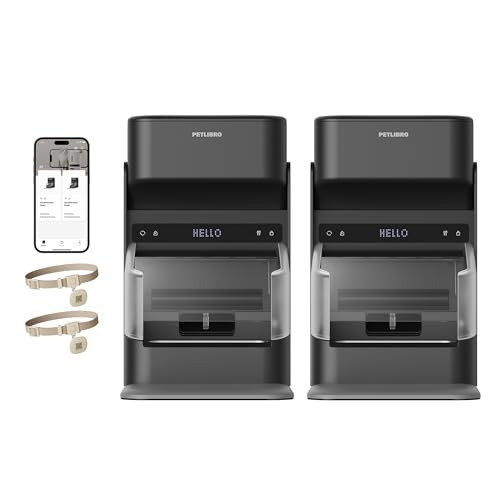
PETLIBRO RFID Cat Feeder 2-Pack for Two Cats
This feeder suits a multi-cat home where each cat needs a predictable portion and a secure place to eat. A lightweight RFID collar tag identifies your cat, and the lid opens only after recognizing the assigned tag, giving you control over who reaches the food.
The Pawsense app adds useful context by recording each cat’s meal times and portions. Compared with the raised Vancpet RFID Feeder Stand, this model handles diet separation and meal tracking, while the stand addresses feeding height.
Notable Gains
- Ten scheduled meals and as many as 48 portions per meal support varied routines.
- Dual-band 2.4 GHz and 5 GHz Wi-Fi supports remote app access on newer and older networks.
- The 3 L container reduces refill frequency for a single cat.
- A removable stainless steel bowl simplifies the daily cleaning routine.
- Five-part freshness system combines a sealed lid, gasket, rotor, desiccant, and access lid.
Trade-Offs To Consider
- The collar sensor only works with the included RFID tag, and every participating cat needs an assigned tag.
Quick Facts
Who It Suits Best
You benefit most from this feeder when your cats need different portions or diets and you want app-based meal records.
Where Another Pick Suits Better
The Temora Vision Automatic Cat Feeder Camera 6 Compartments suits cats that cannot comfortably wear collar tags and need varied wet or dry meals.
Two matching feeders give you a straightforward way to separate cats with different diets without placing every bowl on opposite sides of the home. Each unit uses a dedicated light collar tag, so your cats can approach their own station while another pet remains outside the food access area.
Compared with the single PETLIBRO RFID Automatic Cat Feeder 3L 5G Wi-Fi, this bundle spreads the setup across two stations and adds silicone floor mats. That makes it more practical for a permanent two-cat arrangement, though it requires twice the counter and floor space.
The Helpful Details
- Two dedicated stations support separate feeding plans in the same room.
- App scheduling allows you to set several meals for either cat.
- Meal reports show eating times and frequency for better routine monitoring.
- A manual feeding option handles an extra snack outside the schedule.
- The silicone mats help contain scattered kibble and simplify cleanup beneath the bowls.
Practical Considerations
- Each feeder has a 3 L tank, so both stations need regular refilling and adequate counter space.
- Recognition depends on the supplied light collar tags rather than a universal tag system.
- Three lid speeds and a 1-to-10-second closing delay require a short adjustment period for cautious cats.
Made For
You get the most value when two cats share a home but require separate meals and close supervision of their eating patterns.
Consider Something Else When
The PETLIBRO RFID Cat Feeder 2-Pack for Two Cats is a better fit when you want a cleaner matched pair without floor mats.
This accessory shifts the focus from food access to feeding posture. Raising the matching RFID feeder reduces the distance your cat must lower its head, which can make daily meals more comfortable for senior cats and may suit a feeding corner that feels crowded at floor level.
The four-leg base offers a straightforward support structure, and setup requires attaching the legs before placing the feeder on top. Unlike the Temora Vision Automatic Cat Feeder Camera 6 Compartments, this stand adds no recognition or scheduling functions, so it works only as a physical accessory.
Positive Takeaways
- The raised position reduces deep head lowering during daily meals.
- Four legs create a steady platform for the matching feeder.
- Tool-free-looking assembly keeps setup uncomplicated.
- A raised station can make a dedicated feeding corner look more orderly.
Small Caveats
- The feeder is sold separately, so this stand is not a complete feeding station by itself.
- Compatibility is limited to the matching RFID feeder rather than universal models.
- You need enough clearance above the stand for the feeder lid and your cat to approach comfortably.
Key Specs
Right Fit For
You benefit most when your senior cat prefers a higher bowl position and you already own the compatible RFID feeder.
Not Your Match When
The PETLIBRO 5L Wi-Fi Automatic Feeder Low Food Sensor is a better fit when you need a complete feeder rather than a height accessory.
Face recognition makes this the most different option in the lineup. Your cat needs no RFID collar tag or implanted microchip; register up to ten cat profiles in the app, and the feeder recognizes an assigned face before presenting that cat’s meal.
The rotating tray accepts wet food, kibble, or fresh meals, while the camera adds remote viewing and two-way audio when the feeder is connected. Compared with the PETLIBRO RFID Automatic Cat Feeder 3L 5G Wi-Fi, this model favors meal variety and collar-free access over tag-based diet logs.
Everyday Wins
- Face recognition suits cats that object to wearing a collar tag.
- Six compartments separate different meal types or portions.
- Five removable stainless steel bowls make tray cleaning more convenient.
- Two reusable ice packs help maintain cooler perishable meals.
- Core recognition and meal access continue offline while power remains connected.
Where It May Fall Short
- The tray accommodates about 1.2 L in total, so it needs more frequent loading than a large kibble hopper.
- Newly introduced cats need time to learn the access routine.
- Remove uneaten perishable food promptly and follow the food maker’s storage guidance.
Feature Snapshot
Who Will Love This
You get the strongest fit with multiple cats, collar-free recognition needs, and a mix of wet, dry, and fresh foods.
A Better Fit Elsewhere
The PETLIBRO RFID Feeder 2-Pack with Silicone Mats suits a household that specifically wants tag-controlled access for two cats.
This cover is a physical barrier for a specific microchip feeder rather than a complete automatic feeding system. Its cat-shaped opening limits how a larger or determined pet can reach the food, which may help in a home where another cat or dog approaches the feeder opening after the intended cat has been identified.
The trade-off is compatibility and physical fit. Unlike the PETLIBRO RFID Automatic Cat Feeder 3L 5G Wi-Fi, this cover cannot schedule meals or record which cat ate, so it works best alongside a compatible microchip feeder and the access control already built into that machine.
Advantages To Know
- Creates a physical barrier around the feeder opening.
- Adds separation without another full electronic feeder.
- Can reduce crowding around a microchip feeder during meal times.
Details To Watch
- The opening is unsuitable for kittens and very slender cats.
- You must verify that the opening matches the shape and dimensions of your microchip feeder.
- It adds access control without portion scheduling or diet records.
Built With In Mind
You benefit most when you already own a compatible microchip feeder and need a front barrier for larger household pets.
Another Choice May Suit
The PETLIBRO RFID Automatic Cat Feeder for Personalized Meals suits a household that wants collar-based identification with app scheduling.
A large food capacity makes this a practical alternative for a single cat, a dog, or a household that does not need separate access for every pet. The 5 L hopper holds more kibble than the 3 L RFID models, reducing refill frequency during a busy week.
App-based scheduling supports as many as 10 meals, and each meal can contain one to 48 portions. Unlike the PETLIBRO RFID Automatic Cat Feeder for Personalized Meals, this feeder schedules by time and portion rather than by cat recognition, so it is a simpler fit for one pet sharing a home.
Strengths Worth Knowing
- The 5 L tank suits pet households that prefer fewer refills.
- Dual-band Wi-Fi supports access on 2.4 GHz and 5 GHz networks.
- Ten daily meals and 48 portions per meal provide scheduling flexibility.
- A low-food sensor helps you notice when the hopper needs replenishing.
- Freshness preservation supports kibble storage between feedings.
Factors To Consider
- There is no RFID or facial recognition, so another pet can reach an unattended bowl.
- The larger hopper needs more storage space than the 3 L models.
- Automatic dispensing does not show which household pet ate a scheduled portion.
Technical Highlights
The Right Fit
You benefit most from a high-capacity timed feeder for a single pet or a home where shared mealtime access is acceptable.
Look Elsewhere When
The PETLIBRO RFID Cat Feeder 2-Pack for Two Cats suits a multi-pet home that needs a separate recognized station for each cat.
This single RFID feeder centers on personalized portions and controlled access. Your cat wears a unique collar tag, and the feeder identifies that tag before unlocking the bowl, which helps preserve individual feeding plans in a shared home.
Diet tracking adds another layer for a household that wants to review meal timing and quantities. Compared with the PETLIBRO 5L Wi-Fi Automatic Feeder Low Food Sensor, this model adds cat recognition and access control, although its smaller hopper calls for more frequent refilling.
Real Benefits
- RFID access gives your cat a dedicated meal without a second full feeder.
- Diet records show when your cat ate and how much.
- Adjustable lid speed helps your cat become comfortable with the moving cover.
- Wi-Fi programming keeps meal times and portions under app control.
Possible Compromises
- Only the supplied RFID collar tag is supported.
- A single feeder serves one recognized cat at a time, even in a multi-pet home.
- Your cat must tolerate a collar and approach the lid to trigger access.
Whose Shelf It Belongs On
You get the best fit with one cat that needs a specific diet, collar tag, and recorded meal routine.
Where A Sibling Pick Shines
The PETLIBRO RFID Feeder 2-Pack with Silicone Mats suits a home where two cats need separate stations and floor cleanup support.
Two coordinated feeders give each of your cats an independent station while allowing both to operate on the same schedule. Unique RFID collar tags identify the appropriate cat at each unit, so separate diets can remain in place without forcing your cats into different rooms.
The pair is visually and functionally more focused than the PETLIBRO RFID Feeder 2-Pack with Silicone Mats because it omits the floor mats and concentrates on matched access. You gain parallel operation, though two covered bowls and two food reservoirs require more counter space.
Reasons It Performs
- Independent recognition gives two cats separate feeding access.
- Simultaneous operation supports shared schedules and different portions.
- Unique collar tags maintain a clear assignment for each station.
- Adjustable lid speed lets you match the opening pace to each cat.
- Diet tracking helps you compare the eating patterns of both cats.
Worth Bearing In Mind
- The included RFID tags are the supported identification method.
- Two 3 L feeders need more storage and two separate refilling routines.
- Your cats need a shared feeding area that remains calm enough for lid operation.
Core Details
Who Should Grab It
You benefit most when two cats share a home, need distinct meals, and will use matched feeding stations.
Reach For A Different Pick When
The Temora Vision Automatic Cat Feeder Camera 6 Compartments suits a household that needs collar-free recognition and a wider range of meal types.
What Matters Before You Bring Home an Automatic Feeder
Start with the number of cats
One cat with a consistent routine may need only a timed feeder with generous capacity. Two cats with different diets benefit from separate RFID stations, while a larger group makes face-based recognition and multiple meal compartments worth a closer look.
Match the food to the machine
Kibble-oriented hoppers suit dry food and offer simple portion control. Wet food, fresh meals, and mixed portions call for removable bowls, divided compartments, and a way to keep perishable food chilled for the period it remains in the tray.
Check recognition around your cat’s comfort
RFID feeders depend on a collar tag, while face recognition removes that requirement but changes how access control works. Consider whether your cat already tolerates a collar and whether your household has a calm place for the feeding station.
Measure the setup before ordering
Check the feeder’s footprint, lid clearance, counter height, and nearby storage. A raised stand, paired feeders, or six-compartment tray can make a feeding corner more comfortable, but each addition also claims room that your cats need to approach and eat safely.
Practical Details That Change Daily Feeding
Mistakes Worth Dodging
A common mistake is counting on an RFID feeder to separate cats without giving each animal the correct assigned tag. Another is choosing a wet-food tray for kibble, or a collar-based model for a cat that will not wear a collar comfortably. Measure the feeding area and compare the bowl opening with your cat’s build before ordering.
What Separates Premium From Basic
Higher-tier models tend to add recognition, camera functions, multiple bowls, or paired stations rather than simply more food capacity. Those additions matter when several cats have different diets or your daily routine makes manual feeding inconsistent. A single-pet household can often get more value from a dependable timed feeder with a lower-food sensor and a large hopper.
Frequently Asked Questions
What does an RFID cat feeder do?
An RFID cat feeder identifies a cat through a collar tag and releases food only when the assigned tag appears. This supports separate portions and reduces access to another pet’s meal.
Do all cats need RFID collars?
No. RFID models need a compatible collar tag, while face-recognition models identify cats through the camera and app. Choose based on your cat’s comfort with collars.
Can an automatic feeder serve wet food?
Some models can, but you must confirm the feeder has suitable removable bowls or compartments. Perishable food also needs proper chilling and timely removal according to the food maker’s guidance.
How many meals can these feeders schedule?
The featured PETLIBRO models support up to 10 scheduled meals per day, with individual portion limits. The Temora Vision model uses a rotating tray for scheduled or self-service meal access.
Which option suits two cats with different diets?
The PETLIBRO RFID Cat Feeder 2-Pack for Two Cats gives each cat an assigned station. The PETLIBRO RFID Feeder 2-Pack with Silicone Mats adds floor mats, making it a stronger option when kibble scatter is a concern.
Final Verdict
Your best decision starts with the feeding problem: collar-based access for separate diets, face recognition for collar-free households, or a simple timed feeder for one pet. PETLIBRO offers the broadest range of RFID configurations, while the Temora Vision model stands apart for wet food variety and camera-based monitoring. Match the feeder to your cats, your food, and your available space before making the final choice.