
A network-attached storage device keeps photos, documents, and media on a private network that household devices can access. I put four NAS enclosures and two family calendar displays together because both categories solve a common home problem: organizing information in a central, easy-to-reach place. The NAS models suit people who want dedicated file storage, while the calendar displays serve families managing appointments, chores, and meal plans. Their difference matters because a calendar display organizes schedules but does not provide a NAS enclosure or hard-drive bays.
The Picks In Brief

Herncptar 21.5-Inch Touchscreen Digital Calendar
QNAP TS-464 4-Bay Desktop NAS

Synology DS223j 2-Bay NAS with 8TB IronWolf

QNAP TS-216G 2-Bay 2.5GbE NAS

TERRAMASTER F2-425 Plus 2-Bay NAS

Herncptar 10.1-Inch Full HD Family Calendar
A Deeper Look At The Lineup
A shared wall calendar becomes more useful when it can display appointments, chores, meals, and family photos on one screen. The 21.5-inch format gives this model enough room to function as a central information panel in a kitchen, home office, or common hallway. It is a scheduling display rather than a NAS, so I would pair it with one of the storage enclosures later in this list for a combined household setup.
The 1920-by-1080 IPS touchscreen uses In-Plane Switching, a display technology that preserves color and viewing angles from more positions. Adjustable fonts and several themes help different household members work with the same schedule. The touchscreen, stand, and mounting hardware make wall installation or counter placement practical, depending on the room.
A Few Strong Suits
- Google Calendar, iCloud, and Outlook synchronization centralize family appointments.
- Chore assignments and reward points turn a schedule into a household progress tracker.
- Photo frame mode makes the screen useful outside planning hours.
- The included stand supports desk and countertop placement.
- Basic app features carry no recurring charge.
Practical Considerations
- The large panel needs an uncluttered wall or counter, and the chore system depends on regular family participation.
Feature Snapshot
Made For
Families with several schedules, children completing chores, or grandparents who benefit from larger text benefit most from this display.
Where Another Pick Suits Better
The QNAP TS-464 4-Bay Desktop NAS better serves households that need centralized file and photo storage rather than a touchscreen planner.
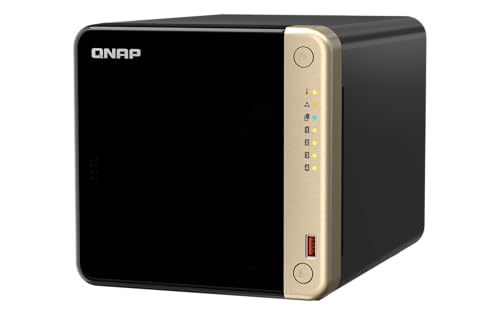
Four drive bays give the TS-464 room to grow as photo libraries and household documents accumulate. It is more appropriate than the calendar display for centralized storage, while still fitting a home office or media cabinet. The four-bay layout also gives this QNAP more expansion room than the two-bay models in this group.
Its Intel Celeron processor has four cores and a burst speed up to 2.9 GHz, paired with 8GB of DDR4 memory. Two 2.5GbE ports provide faster network access than a single 1GbE connection, particularly when several household devices request files simultaneously. Intel AES-NI encryption support adds hardware-assisted handling for encrypted data.
What It Does Well
- Four SATA bays support a larger storage layout than competing two-bay units.
- Dual 2.5GbE ports suit modern networks with several active clients.
- 8GB of memory provides more headroom than the entry-level Synology configuration.
- SATA 6 Gb/s drive interfaces fit high-capacity desktop storage.
Small Caveats
- The larger enclosure and four-bay layout need more shelf or desk space than the TS-216G.
- Fast 2.5GbE transfer rates depend on compatible network hardware and cabling.
Technical Highlights
Right Fit For
Home users managing growing photo archives, shared documents, and several connected devices benefit from the four-bay layout.
Consider Something Else When
The QNAP TS-216G fits smaller living spaces where two bays and a compact enclosure are more practical.
For a household that wants a NAS and storage media together, this bundle removes the need to assemble both parts separately. The DS223j includes two 4TB Seagate IronWolf hard drives, giving the enclosure 8TB of included capacity. That arrangement works particularly well for a family photo library, shared documents, or automatic household backups.
Inside, a Realtek RTD1619B four-core processor runs at 1.7 GHz with 1GB of DDR4 memory. A single 1GbE network port keeps the connection straightforward, though it is less future-oriented than the dual 2.5GbE arrangement in the QNAP TS-464. DiskStation Manager provides the interface for storage, file sharing, and private cloud access.
Good Reasons To Consider
- Two 4TB IronWolf drives provide 8TB of included storage.
- The complete package suits first-time NAS owners.
- DiskStation Manager supports file sharing, synchronization, and private cloud use.
- Surveillance-oriented storage tools can support home camera recording.
Less-Strong Areas
- The 1GB memory configuration is modest next to the 8GB QNAP TS-464.
- One 1GbE port can limit transfers compared with dual faster network connections.
- Two bays offer less expansion flexibility than a four-bay enclosure.
Who Will Love This
First-time NAS users and families wanting an enclosure with 8TB of included drives will find this bundle easier to assess.
Another Choice May Suit
The QNAP TS-464 4-Bay Desktop NAS better fits users who value more memory, faster networking, and additional drive expansion.
The TS-216G narrows the QNAP approach into a two-bay enclosure suited to apartments, home offices, and modest storage needs. It supports file access, sharing, synchronization, productivity applications, and multimedia tools through QNAP’s management platform. Compared with the larger TS-464, it preserves the faster dual 2.5GbE network while reducing the physical bay count.
Its ARM Cortex-A55 processor has four cores running at 2.0 GHz, a lower clock speed than the Intel N150 in the TERRAMASTER F2-425 Plus. That difference matters for users who expect heavier application work, while basic household file storage remains the more natural focus. In a typical living room, its smaller footprint may matter more than maximum processor speed.
Where It Excels
- Dual 2.5GbE ports outpace the single 1GbE connection in the Synology DS223j.
- The two-bay format suits compact home-office shelving.
- Multimedia and productivity applications broaden its role beyond simple file storage.
Some Limits To Know
- Two bays provide less expansion room than the four-bay TS-464.
- The 2.0GHz processor trails the N150 configuration in the F2-425 Plus.
Quick Facts
Built With In Mind
Apartment dwellers, small-office operators, and home users with limited shelf space benefit from the compact two-bay layout.
Reach For A Different Pick When
The TERRAMASTER F2-425 Plus 2-Bay NAS fits users who need a stronger processor, dual 5GbE, and dedicated M.2 expansion.
The F2-425 Plus brings more computing capacity to a two-bay desktop NAS than the simpler enclosures in this group. Its Intel N150 processor has four cores and boosts up to 3.6 GHz, while 8GB of non-ECC DDR5 SODIMM memory supports more demanding NAS applications. The dual 5GbE ports also exceed the 2.5GbE connections offered by both QNAP models.
Three M.2 positions add a useful storage layer without occupying the two conventional drive bays. M.2 is a compact SSD form factor, and the slots can support caching or independent storage pools according to the configuration. This makes the F2-425 Plus appropriate for households that want fast storage alongside large hard-drive capacity.
Standout Benefits
- The Intel N150 offers the highest processor specification here.
- Dual 5GbE ports support faster network transfers over compatible equipment.
- Three M.2 slots create options for cache or separate storage pools.
- 8GB of DDR5 memory provides room for more demanding workloads.
- The enclosure remains limited to two standard hard-drive bays.
Points To Keep In Mind
- The diskless configuration requires separate hard drives.
- Its advanced hardware and storage additions raise the total ownership considerations.
- Fast network performance depends on compatible switches, cables, and client devices.
The Right Fit For
Technical home users, creative professionals, and data-heavy households benefit from the processor, memory, and M.2 flexibility.
A Better Fit Elsewhere
The QNAP TS-464 4-Bay Desktop NAS better fits storage-focused households that need more hard-drive expansion and fewer compute-focused features.
A smaller display can make better sense in a kitchen or entryway where a 21.5-inch panel would dominate the available surface. This 10.1-inch touchscreen combines calendar synchronization, a digital planner, and a photo frame in a compact enclosure. It suits families that want one glanceable schedule without installing a large wall-mounted system.
Color-coded entries distinguish schedules for different family members, while Apple and Google calendar synchronization keeps shared appointments in one place. The Full HD resolution provides a crisp surface for the 2026 calendar system. Compared with the larger Herncptar display, this model trades visible detail for a footprint that fits more naturally into compact rooms.
Points In Its Favor
- The 10.1-inch display fits limited counter and wall space.
- Color coding separates schedules for multiple family members.
- Apple and Google calendar synchronization reduces manual schedule entry.
Details To Watch
- The smaller panel presents less schedule detail than the 21.5-inch Herncptar model.
- Its stated calendar synchronization covers Apple and Google rather than Outlook.
Core Details
Whose Shelf It Belongs On
Compact kitchens, entryways, and home offices benefit from a schedule display that stays out of the way.
Where A Sibling Pick Shines
The Herncptar 21.5-Inch Touchscreen Digital Calendar better fits families that want larger text, more visible schedule detail, and Outlook synchronization.
What Matters Before Adding Network Storage
Start With the Storage Layout
I begin with the number of drives a household expects to use now and over the next few years. A two-bay enclosure suits a modest photo library and mirrored backups, while four bays provide more flexibility for separate media or expanded capacity. The Synology DS223j bundle also includes two 4TB IronWolf drives, a convenience the diskless TERRAMASTER model does not offer.
Match the Network Speed
The meaningful network comparison is between 1GbE, 2.5GbE, and 5GbE, each representing a progressively faster Ethernet standard. The DS223j uses a single 1GbE port, both QNAP enclosures provide dual 2.5GbE connections, and the F2-425 Plus has dual 5GbE. Faster links require compatible routers, switches, cables, and client devices to deliver the corresponding benefit.
Compare the Management Platform
Synology DiskStation Manager centers on storage, synchronization, private cloud access, and home camera recording. QNAP adds productivity and multimedia applications across its desktop models, while TERRAMASTER combines those categories with a more compute-oriented configuration. I would prioritize the platform that matches the household’s actual management tasks rather than comparing interface style alone.
Account for Expansion and Setup
Drive bays determine how easily storage can grow, while M.2 slots add a separate layer of configuration choices. The F2-425 Plus supports three M.2 devices, although it remains a two-bay hard-drive system. Physical placement, drive compatibility, and network hardware deserve attention before installation because replacing a misplaced NAS or incompatible component can disrupt the setup.
Practical Lessons Before Installation
Mistakes Worth Dodging
A fast network label cannot create speed without compatible hardware at every link, so I check the router, switch, cables, and client devices together. I also avoid assuming that a bundled NAS includes everything needed, since storage media, mounting hardware, and network equipment can remain separate considerations.
What Separates Premium From Basic
Extra money can buy faster networking, more memory, additional drive bays, or M.2 expansion. Those upgrades matter most for large libraries, frequent transfers, camera backups, or application-heavy use. Basic two-bay models remain sensible when the household mainly needs straightforward file sharing and modest capacity.
Frequently Asked Questions
Do I need a NAS for home use?
A NAS is useful when several household devices need shared storage, synchronized files, or centralized photo libraries. A simple external drive works for occasional local use, but it does not provide the same network sharing model.
Is a two-bay NAS enough?
A two-bay NAS can serve a modest household with mirrored storage or a single large drive. The QNAP TS-464 offers more room for expansion through four bays, while the Synology bundle includes 8TB of storage.
What does 2.5GbE change?
2.5GbE provides a faster Ethernet connection than 1GbE and can reduce transfer bottlenecks on suitable networks. The improvement also depends on compatible network equipment and client devices.
Should I choose a NAS with drives included?
A bundled NAS simplifies initial setup and makes total capacity easier to understand. The TERRAMASTER F2-425 Plus is diskless, so its storage media must be selected separately.
Are digital calendars NAS devices?
No, a digital calendar organizes schedules and household tasks rather than providing file storage or drive bays. The Herncptar models can complement a NAS in a connected family setup.
Final Takeaway
The QNAP TS-464 offers the most balanced four-bay layout, while the Synology DS223j bundle is the clearest path to immediate two-bay storage. Compact homes may prefer the TS-216G, and compute-heavy users will find more headroom in the TERRAMASTER F2-425 Plus. For family scheduling, the 21.5-inch Herncptar display offers more room, while the 10.1-inch version suits tighter spaces.