
A home studio with three guitars leaning against a wall becomes frustrating fast. Multiple guitar stands solve that clutter while giving each instrument a defined place, and I’ve compared six options for capacity, portability, instrument compatibility, padding, storage, and construction.
A Fast Comparison Of The Options

String Swing CC34-29-BW Guitar and Case Floor Rack, Walnut

tipatyard 5 Guitar Foldable Rack with 12 Picks, 4 Thicknesses

tipatyard 3-Holder Multi Guitar Rack with Thick Rubber Padding
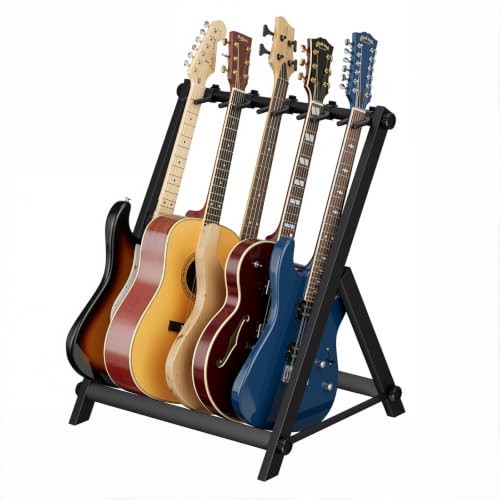
tipatyard 5-Holder Multi Guitar Rack with Thick Rubber Padding

Vantimo 5-7 Guitar Multi Rack with Storage Shelf and Side Hooks, Rustic Brown

tipatyard 3 Guitar Foldable Rack with 12 Picks, 4 Thicknesses
More Details On Our Top Picks
Guitar cases stacked beside a sofa take up more room than the instruments themselves. This String Swing rack handles up to six guitars and five cases, giving a serious collection separate storage positions rather than relying on temporary corners.
Hand-welded steel forms the supporting structure, while hardwood contributes the guitar and case contact points. The walnut finish suits a visible music room, and both rack sections fold flat for transport or tighter storage. Assembly reportedly needs only a screwdriver, which keeps setup straightforward.
Benefits That Matter
- Accommodates six guitars and five cases in one coordinated unit.
- Combines welded steel with hardwood contact components.
- Folding sections make the rack easier to reposition.
- Walnut construction suits furniture-like room displays.
Practical Considerations
- The full-size rack needs adequate floor space for six instruments and five cases.
- A screwdriver is required for basic assembly.
Key Specs
Made For Serious Collections
This rack best suits musicians with several guitars and multiple hard cases in a dedicated music room or studio.
A Better Fit Elsewhere
The Vantimo 5-7 Guitar Multi Rack with Storage Shelf and Side Hooks, Rustic Brown better serves collections that also include cellos, banjos, or ukuleles.
A guitarist who moves between rehearsal rooms needs storage that travels as neatly as it works at home. This tipatyard rack holds five guitars and folds for transport, making it a practical choice for stages, studios, workshops, and changing practice spaces.
The supports accommodate acoustic, electric, and bass guitars, so a mixed collection can share one frame. A foldable design also reduces setup and packing time. I would still check the folded dimensions against a vehicle or rehearsal-room storage area before planning around it.
Why It Works Well
- Five positions handle a substantial home or rehearsal collection.
- Folding construction supports transport between gigs and rooms.
- One frame works with acoustic, electric, and bass guitars.
- Twelve picks in four thicknesses add useful playing accessories.
Trade-Offs
- Five instruments require enough open floor space for full setup.
- The included picks do not add case storage or a lower shelf.
- Folding hardware occupies space even when the rack is stored.
Who It Suits Best
Mobile musicians who regularly move several guitars between rehearsal, recording, and performance settings gain the most from its folding format.
Reach For A Different Pick When
The tipatyard 3 Guitar Foldable Rack with 12 Picks, 4 Thicknesses is the better fit for a smaller collection that prioritizes padding and a locking support design.
Three guitars occupy a manageable footprint without leaving instruments scattered around a practice room. The three-holder configuration suits a bedroom studio, apartment, or rehearsal corner where a five-position rack would feel restrictive.
Thick rubber padding separates the contact surfaces from the instruments, which matters for neck finishes and body edges. Compatibility extends across acoustic, classical, electric, and bass guitars. The three-position limit is the main constraint, especially for a growing collection.
Advantages To Know
- Rubber padding cushions the contact areas.
- Three positions keep the footprint relatively compact.
- Supports four common guitar families, including classical and bass models.
Small Caveats
- Capacity is limited to three instruments.
- There is no dedicated shelf for cases, picks, or accessories.
Quick Facts
Right Fit For
Home players with three mixed guitars and limited floor space receive the most useful balance here.
Look Elsewhere When
The tipatyard 5-Holder Multi Guitar Rack with Thick Rubber Padding makes more sense for a collection that already includes five instruments.
The step from three to five positions determines the practical difference between this rack and the smaller tipatyard model. Five instruments fit comfortably into a home music room or studio without requiring a large floor-standing storage system.
Thick rubber padding is the defining construction detail, providing softer contact around the supported portions of each instrument. Acoustic, classical, electric, and bass guitars are all listed as compatible. For a mixed five-guitar setup, the balance of capacity and padding is difficult to overlook.
Well-Handled Touches
- Five positions suit established home collections.
- Rubber padding reduces direct contact with instrument surfaces.
- One rack serves acoustic, classical, electric, and bass guitars.
- Black construction blends into many studio spaces.
Practical Considerations
- Five slots require more floor clearance than a three-guitar rack.
- Accessories require separate storage because the design has no shelf.
Made For
Musicians with four or five mixed guitars in a dedicated home or recording space will find the capacity particularly useful.
Another Choice May Suit
The tipatyard 3-Holder Multi Guitar Rack with Thick Rubber Padding fits smaller rooms where conserving floor area matters more than capacity.
A guitar collection that extends beyond standard guitars benefits from a rack designed to accept several instrument types. The Vantimo supports electric and bass guitars, ukuleles, cellos, banjos, and other stringed instruments across five intervals and two hangers.
At 12 inches deep, 20 inches wide, and 52 inches high, this is a substantial piece of furniture rather than a compact folding rack. A lower shelf and side hooks create additional places for cases and accessories. The rustic brown finish also gives a studio or music room a more furniture-like appearance.
Strengths Worth Knowing
- Accommodates guitars and several additional stringed instruments.
- Lower shelf stores accessories without occupying a hanging position.
- Side hooks provide dedicated hanging space.
- Rustic brown finish complements home music-room furniture.
- Five intervals and two hangers create a flexible layout.
Factors To Consider
- The 52-inch height requires adequate vertical clearance.
- The 20-inch width and 12-inch depth call for a dedicated floor area.
- Its fixed construction does not offer the folding portability of several tipatyard racks.
Feature Snapshot
Whose Shelf It Belongs On
This rack suits a spacious home studio or music room that houses guitars, cases, and several different stringed instruments.
Swap It Out When
The String Swing CC34-29-BW Guitar and Case Floor Rack, Walnut is the stronger fit for collections dominated by guitars and hard cases.
Portability and instrument support can coexist more successfully here than in a large fixed rack. This three-position tipatyard model folds down for movement between a home, stage, studio, or workshop, while accommodating acoustic, electric, and bass guitars.
Soft foam covers the upper neck cradles and lower supports, reducing contact where finishes are most vulnerable. A locking design helps keep each instrument in place, and the wide leaning angle creates room for varied body shapes. I would verify the fit of unusual or unusually wide instruments before relying on the supports.
Everyday Advantages
- Folding construction simplifies transport and compact storage.
- Foam padding covers both the upper and lower contact points.
- The locking support helps prevent instruments from shifting.
- Three guitars keep the frame manageable for mobile use.
- Twelve picks in four thicknesses accompany the rack.
Possible Compromises
- Three positions limit larger collections.
- No shelf is included for cases or accessories.
Core Details
Built With In Mind
Mobile musicians carrying three standard guitars benefit most from the folding frame, padded contacts, and locking supports.
Where A Sibling Pick Shines
The tipatyard 5 Guitar Foldable Rack with 12 Picks, 4 Thicknesses is the better choice for musicians who need to transport five instruments.
What Matters Before Bringing Home a Multi-Instrument Rack
Capacity and collection size
I start with the number of instruments that need permanent homes, not a hypothetical maximum. A three-guitar rack works well for a bedroom studio, while five positions suit a collection that has already outgrown wall hangers. Case storage needs separate consideration because most racks support instruments rather than storing loaded cases.
Portability versus stability
A folding frame is valuable for rehearsals, shared studios, and changing practice spaces. Fixed models generally provide a larger visual presence but avoid repeated folding and setup. In a permanent studio, that trade may be acceptable; on the road, compactness becomes more valuable.
Instrument shape and contact surfaces
Rubber and foam padding soften the areas that touch an instrument, while wider spacing helps accommodate unusual body shapes. Acoustic, electric, classical, and bass guitars are commonly listed as compatible, but the neck profile and body width still deserve a close look before a crowded rack is filled.
Storage and room dimensions
A shelf or side hooks can hold accessories without consuming instrument positions. Large racks need enough floor and vertical clearance, so measuring the intended corner prevents a practical storage solution from becoming a room obstruction.
Common Mistakes Worth Avoiding
Pitfalls Shoppers Hit
Counting only guitars and overlooking cases is a common error. I also check the folded dimensions and the room’s height before choosing a large model, since floor width alone does not reveal the full footprint.
Wrong Turns To Avoid
Padding deserves attention, but fit matters just as much. An instrument with an unusually wide body or distinctive neck contour may need more clearance than a standard model provides.
What Separates Premium From Basic
Where The Extra Money Goes
Added construction detail, wider spacing, integrated storage, and folding hardware often separate more elaborate racks from basic models. A case-oriented design can justify added cost for a large collection, while portable musicians may receive more value from a compact padded frame.
The Upgrade Payoff
A larger rack helps only when it fits the available space. I would pay for stronger contact materials or useful storage before adding unused positions, and I would favor portability whenever the rack must move between rooms or venues.
Frequently Asked Questions
How many guitars should a multiple guitar stand hold?
A multiple guitar stand should match the number of instruments needing regular storage. Three positions suit smaller collections, while five or more become useful for a dedicated home or studio setup.
Are padded guitar stands better for instruments?
Padded contact points can reduce direct contact with finishes and body edges. Fit, spacing, and stability remain important because padding alone does not guarantee proper support for every instrument shape.
Can one multi-guitar stand hold different instrument types?
Many models support acoustic, electric, classical, and bass guitars, while broader designs may also accept ukulele, banjo, or cello. I would compare the listed instrument types with the collection and check unusual dimensions.
Are folding guitar stands convenient for travel?
Folding stands reduce the space required during transport and setup. I would check the packed dimensions and carrying weight against a vehicle, rehearsal room, or stage-storage area.
What should I look for in a guitar rack with storage?
A lower shelf, side hooks, and dedicated accessory spaces can improve organization. I would also check the load-bearing layout and confirm that the added storage does not reduce instrument spacing.
Final Verdict
String Swing leads for large collections that include hard cases, while the tipatyard models offer several practical combinations of folding construction, padding, and capacity. The Vantimo rack stands apart through its shelf, side hooks, and support for varied stringed instruments. Match the frame to the collection, room, and need for portability rather than choosing by instrument count alone.