
A home lock has to do more than look reassuring on a front door. It must suit the frame, the family’s daily routine, and the level of control expected from a deadbolt, keypad, or connected lock. I focus on six practical options for strengthening an entry, simplifying key handling, and adding remote access without overlooking installation requirements or door compatibility.
The Leading Options At A Glance

WINONLY Front Door Reinforcement Lock

Rerishom Child-Safe 2-Pack Reinforcement Lock

Schlage Camelot Keypad Lock, Aged Bronze

Philips Wi-Fi Smart Deadbolt Lock
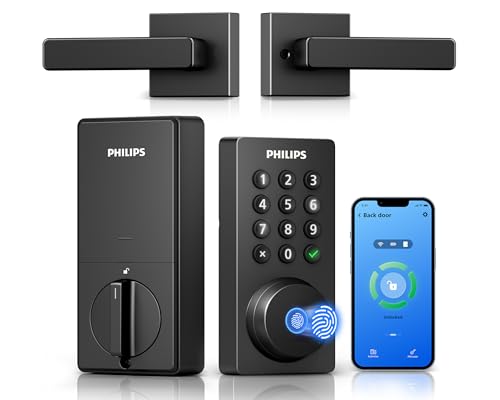
Philips WiFi Keypad Deadbolt with Handle

Philips Upgraded Wi-Fi Smart Lock with Handle, Fingerprint, App Control
A Closer Look At Each Pick
The deadbolt catches, but the surrounding frame may still be the weak point. I treat the WINONLY Front Door Reinforcement Lock as a way to brace a standard entry rather than a full lock replacement, which makes it relevant for a rental, an older door, or a home that already has a serviceable deadbolt.
The 3-inch stop closes the gap between the door and frame, while the included fasteners accommodate different installation depths. Compared with the Rerishom 2-Pack Reinforcement Lock, this option uses a metal construction and a single-lock format, so I would favor it for one heavily used front door. The tradeoff is that it does not provide electronic entry or app control.
Key Advantages
- The frame stop adds resistance where a latch can otherwise pull against the strike area.
- Eight screws, split between longer and shorter lengths, support different frame thicknesses.
- A 3-inch stop provides a defined contact point between the door and frame.
Practical Considerations
- The source states a force capacity of 800 pounds, but real performance still depends on solid framing and correct placement.
- Existing door hardware may need removal, so latch and frame dimensions deserve checking before installation.
Key Specs
Made For
This fits people with a serviceable deadbolt who want stronger frame support without changing to a connected lock.
Another Choice May Suit
The Rerishom Child-Safe 2-Pack Reinforcement Lock fits households seeking two aluminum reinforcement units rather than one metal stop.
Two entry points often need the same attention, particularly in a home with a front door and a rear entrance. I see the Rerishom Child-Safe 2-Pack Reinforcement Lock as a practical option for covering both openings, especially when a child-focused latch is desired without installing a full electronic system.
Unlike the heavier-looking WINONLY frame stop, these units use an aluminum alloy body and mount with four screws. The installation description also calls for a 1/8-inch drill bit and estimates completion within five minutes, though actual setup varies with the frame and existing hardware. The honest limitation is that the set reinforces rather than replaces the existing deadbolt.
A Strong Showing
- Two units provide coverage for separate entry doors or a replacement kept on hand.
- Aluminum alloy construction keeps the hardware focused on straightforward reinforcement.
- The included drill bit and mixed-length screws simplify preparation for a standard installation.
Small Caveats
- Four mounting screws are used per lock, with four long and four short screws supplied across the pair.
- Child-oriented design does not replace the need for a functioning deadbolt and responsible key control.
Right Fit For
Families securing more than one exterior opening will get more value from the paired format than from a single reinforcement stop.
A Better Fit Elsewhere
The Schlage Camelot Keypad Lock, Aged Bronze suits people replacing the existing hardware with a lever and keypad entry system.
A lever with a keypad feels familiar, which makes the Schlage Camelot Keypad Lock, Aged Bronze easier to integrate into a conventional home. I would consider it for a garage entrance, home office, or interior room where removing a physical key from the routine matters more than remote control.
The lock fits most standard door preparations and uses a 9-volt battery for its keypad electronics. A flex-lock design and switch between unlocked and automatic relocking add practical entry control, while the aged bronze finish suits traditional interiors. Unlike the connected Philips models, it adds code entry without Wi-Fi dependence.
Points In Its Favor
- Keypad entry removes the need to carry a key for routine access.
- The lever shape supports familiar handling on office, garage, and secondary-entry doors.
- Automatic relocking offers a clear way to reduce the chance of leaving the door open.
Where It May Fall Short
- Remote unlocking and household access management are outside its feature set.
- Door thickness, bore placement, and the existing lever opening need to align with the stated fit for most standard preparations.
Feature Snapshot
Who Will Love This
People wanting a familiar lever and keypad entry without a connected home system will find this a measured upgrade.
Not Your Match When
The Philips Wi-Fi Smart Deadbolt Lock fits households that need app-based control and several keyless access methods.
Remote entry matters in homes where children, relatives, or caregivers may need temporary access without a physical key. I see the Philips Wi-Fi Smart Deadbolt Lock as a flexible middle ground between a keypad-only model and a fingerprint-centered handle, since it supports app, passcode, fingerprint, key, and voice entry.
Built-in Wi-Fi allows locking and unlocking through a smartphone, which is the main reason to choose this route. The trade-off appears in setup and ownership: batteries are not included, and connected access depends on a stable home network. Compared with the Schlage Camelot Keypad Lock, Aged Bronze, it removes the keypad-only limitation but adds electronic complexity.
Well-Handled Touches
- Five entry routes let household members use the most convenient method for each visit.
- Built-in Wi-Fi supports remote lock control without a separate keypad or handle.
- Physical key access provides a fallback when a battery or network creates an inconvenience.
Details To Watch
- Batteries must be supplied separately before the lock is ready for use.
- App control requires a reliable home network and compatible phone setup.
Built With In Mind
Households sharing access across several people will benefit from the combination of remote permissions, codes, and keyless entry.
Where Another Pick Suits Better
The Philips Upgraded Wi-Fi Smart Lock with Handle, Fingerprint, App Control fits families that prioritize fast fingerprint access and a coordinated lever.
Apartment living can make a multi-part smart-home setup less appealing. I favor the Philips WiFi Keypad Deadbolt with Handle for connected control that links directly to a 2.4 GHz home network, since the specification states that no separate hub or bridge is required.
Smartphone management adds remote convenience, and the handle gives the deadbolt a more substantial feel than a keypad-only cylinder. The catch is network placement: the lock should remain within 33 feet of the router, and walls, metal objects, or interference can weaken the connection. Compared with the Philips Wi-Fi Smart Deadbolt Lock, its defining advantage is the more explicitly documented no-hub network setup.
Reasons It Performs
- Direct 2.4 GHz connection removes the need for a separate network bridge.
- Remote app control makes lock status and entry more convenient for apartments and small homes.
- The handle creates a more conventional grip than many narrow deadbolt faces.
Possible Compromises
- The router-distance requirement may be awkward in large homes or rooms separated by several walls.
- The documented connection uses 2.4 GHz Wi-Fi rather than newer dual-band or tri-band networks.
Core Details
Best Suited To
Apartment residents and compact homes with a strong 2.4 GHz signal will find the direct connection especially useful.
Consider Something Else When
The Schlage Camelot Keypad Lock, Aged Bronze suits a standard door that needs simple keypad access without an app or network.
Placing a fingerprint reader directly on the handle removes a separate access step. I favor the Philips Upgraded Wi-Fi Smart Lock with Handle, Fingerprint, App Control for families that want the lock and the door opening to work as one quick movement.
The stated recognition time is 0.3 seconds, and the lock can store up to 50 fingerprints. App, password, voice, and key access provide additional routes into the home, while automatic relocking supports the close-and-leave routine. Compared with the Philips WiFi Keypad Deadbolt with Handle, the decisive difference is fingerprint-led operation, though the more advanced entry system may be unnecessary for a single occupant.
What It Does Well
- Fingerprint recognition on the handle shortens the entry sequence.
- Storage for up to 50 fingerprints suits a larger family or shared household.
- Automatic relocking reduces the need for a separate door-closing routine.
- App, password, voice, and key access cover different arrival scenarios.
Trade-Offs To Consider
- Fingerprint enrollment and app setup add more configuration than a basic keypad.
- The handle-based design requires more door-hardware attention than a simple deadbolt replacement.
The Numbers That Matter
The Right Fit
Large families and shared homes will benefit most from fast fingerprint access with several backup methods.
Swap It Out When
The Philips Wi-Fi Smart Deadbolt Lock fits people who want several keyless methods but do not need fingerprint recognition on the handle.
What Matters Before Installing a Home Lock System
Door Frame and Latch Fit
I start with the door itself rather than the lock listing. A reinforcement stop needs compatible spacing around the strike area, while a replacement lock needs a matching bore, backset, and lever or deadbolt arrangement. Measuring the door and frame prevents the most common mismatch before any hardware is removed.
Access Method and Daily Routine
A keypad works well for regular household entry, while a fingerprint handle serves people carrying bags or arriving with one hand. Remote app access becomes more valuable when temporary visitors need entry or a door must be checked while away. The best method is the one that remains convenient under normal daily pressure.
Connected Features and Power
Wi-Fi locks add remote control but also require a dependable network connection. Router distance, 2.4 GHz coverage, and nearby walls or metal objects can affect performance, so signal strength deserves attention. Battery requirements also belong in the decision because a connected lock can lose its convenience when its power source is neglected.
Installation Scope and Permissions
A simple frame brace may require less alteration than replacing an entire latch or connected lock. Rental properties call for checking permission before drilling, while families replacing hardware should confirm the door thickness and opening dimensions. A two-pack can cover separate entries, but each frame still needs its own fit check.
Common Mistakes Worth Avoiding
Mistakes Worth Dodging
The most consequential error is choosing by appearance without measuring the door. Another mistake is assuming connected features matter more than the network, battery arrangement, and daily entry routine. Checking frame fit and power requirements first keeps the decision grounded in how the door will actually be used.
The Upgrade Payoff
A premium model can justify its higher cost when remote control, multiple access methods, or a coordinated handle materially improve daily use. A basic reinforcement lock is enough for a solid door and stable deadbolt. Connected hardware earns its place mainly when its convenience solves a recurring household problem.
Frequently Asked Questions
Do I need to replace the entire front-door lock?
No, not necessarily. The WINONLY Front Door Reinforcement Lock and Rerishom Child-Safe 2-Pack Reinforcement Lock support an existing door setup, while electronic models replace the lock itself.
Is a keypad lock better than a conventional deadbolt?
A keypad lock suits people who routinely enter without a physical key. A conventional deadbolt remains the simpler choice for doors that need neither electronic access nor remote control.
Do all smart home locks require a separate hub?
No. The Philips WiFi Keypad Deadbolt with Handle connects to a 2.4 GHz network without a separate hub or bridge, subject to the stated router-distance guidance.
Can a reinforcement lock fit any standard door?
Not every door and frame has compatible clearance around the latch and strike area. Measuring the existing hardware and checking the manufacturer’s dimensions is the sensible first step.
Which option is best for a family with children?
The Rerishom Child-Safe 2-Pack Reinforcement Lock offers a child-focused supplemental latch for more than one entry. A connected keypad model may suit a family seeking controlled codes, but it does not replace ordinary security practices.
Final Verdict
I would choose frame reinforcement for a sound door with a solid deadbolt, a keypad lever for simple keyless entry, and a connected model only when remote control solves a real routine problem. Among the connected choices, the fingerprint-handle design stands apart for fast shared access, while the keypad deadbolt keeps the setup comparatively straightforward. The most satisfying decision comes from matching the hardware to the door and the household’s actual habits.