
A composting toilet for a tiny house has to earn its footprint twice: once by handling waste cleanly and again by fitting into a space where every inch matters. It also has to suit your plumbing, power, and waste-disposal plan rather than forcing your household into an awkward workaround.
The six options below cover very different needs, from compact dry systems for mobile homes to tank-based portable toilets and a small conventional toilet. Some require no plumbing, while others are designed to connect to a conventional water and waste system.
The Choices Worth Comparing

HOROW HWMT-8733S Small One-Piece Dual-Flush Toilet, 12-Inch Rough-In
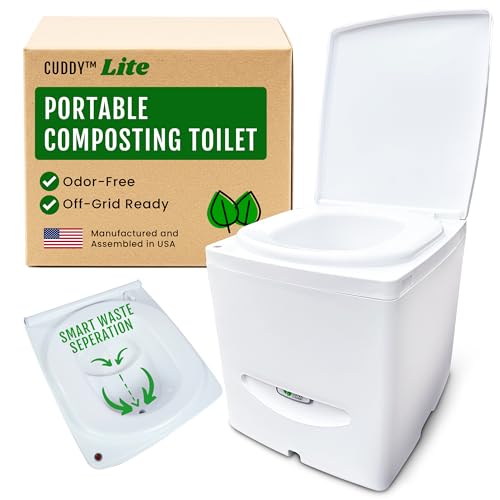
Compo Closet Cuddy Lite Portable Composting Toilet

VINGLI Portable Toilet 5.8-Gallon Tank and Carry Bag

TROBOLO WandaGO Lite Urine-Diverting Dry Toilet

TROBOLO DIY Urine-Diverting Composting Toilet Set

TROBOLO WandaGO Urine-Diverting Toilet with Height Adjustment
Why These Options Stand Out
The HOROW HWMT-8733S takes a different route from the dry systems in this roundup. Its one-piece body measures 25 by 13.4 by 28.4 inches, so it suits a tiny bathroom with conventional plumbing rather than an off-grid toilet area.
The dual-flush control gives you 1.1 or 1.6 gallons per flush, and the concealed trapway leaves fewer exposed corners to scrub. That trade-off is plumbing: you gain a conventional water closet, but you don’t gain a composting design.
A Few Highlights
- The compact body frees valuable wall and floor space in a narrow bathroom.
- Two flush volumes let you use less water for routine visits.
- The skirted trapway simplifies cleaning around the base.
- Both 1/2-inch and 7/8-inch supply lines can connect with an included connection method.
- The silent closing seat adds a practical touch in a compact home.
Practical Considerations
- It requires a water supply and conventional waste connection rather than a self-contained composting system.
- The supply hose must be purchased separately.
Key Specs
Who It Suits Best
This model fits tiny-home residents with conventional plumbing and limited bathroom width.
Where Another Pick Suits Better
The Compo Closet Cuddy Lite Portable Composting Toilet suits off-grid households that need a self-contained dry system.
The Cuddy Lite is built around the reality that many tiny houses and campervans have no sewer hookup. It separates liquid from solid waste without plumbing, chemicals, or household electricity, which gives it a distinctly mobile profile.
Its two-plate drop-zone cover separates the waste streams while an enlarged opening is intended to improve alignment. Unlike the heavier VINGLI model reviewed later, this design prioritizes a small footprint and an alert for the liquid container.
The Value In It
- The waterless design suits cabins, vans, and places without a drainage connection.
- Separating liquids from solids supports a more controlled waste setup.
- The removable solids bin can be lined with a bag for easier handling.
- The LED alerts you when the front liquid container needs attention.
- Flush-fit or freestanding placement gives you layout flexibility.
Small Caveats
- The LED requires a standard 9V battery, which is not included.
- You must plan regular emptying of both waste containers.
Quick Facts
Made For
Mobile households, off-grid cabins, and compact campervans benefit most from its waterless setup.
Another Choice May Suit
The VINGLI Portable Toilet 5.8-Gallon Tank and Carry Bag fits campers who prefer a larger tank-based system.
The VINGLI Portable Toilet takes a different approach from dry composting models. It uses a 3.2-gallon freshwater tank and a 5.8-gallon wastewater tank, giving it the feel of a portable bathroom cabinet rather than a urine-diverting system.
For adult campers, its 440-pound load limit and wide seat offer a practical combination of capacity and comfort. The carry bag also makes it more convenient than a fixed toilet, though the two tanks require adequate storage space.
Everyday Perks
- The 5.8-gallon waste tank supports several uses before emptying.
- A built-in handle and carry bag simplify transport.
- The smooth adult-sized seat is easier to use and clean.
- HDPE and PP construction suit repeated outdoor and emergency use.
Points To Keep In Mind
- The dual-tank design occupies more space than a compact dry toilet.
- It serves as a portable toilet system rather than a true dry composting unit.
The Right Fit
Adult campers, road-trip households, and temporary care situations benefit from its larger tanks and broad seat.
A Better Fit Elsewhere
The TROBOLO WandaGO Lite Urine-Diverting Dry Toilet suits travelers who prioritize a smaller, lighter footprint.
The WandaGO Lite keeps the focus on mobility. At 11.8 by 15 by 13.4 inches and 7.9 pounds, it is easier to load into a campervan storage compartment than the larger WandaGO reviewed later.
Urine diversion keeps liquid waste separate from the solids container, while the SafeShell system adds separation around the internal design. For a mobile bathroom, the honest advantage is less bulk rather than a larger tank capacity.
Benefits That Matter
- The compact dimensions suit narrow van and campervan storage areas.
- Low weight makes the unit easier to move between campsites.
- Urine diversion helps keep the solids container separate from liquids.
- The SafeShell system adds an extra barrier around the separation design.
Where It Is Less Suited
- Its small size offers less capacity than the larger tank-based VINGLI system.
- Placement must allow the cover to open and the containers to be removed.
Technical Highlights
Who Will Love This
Campervan travelers and hikers value its low weight and compact storage footprint.
Reach For A Different Pick When
The TROBOLO WandaGO Urine-Diverting Toilet with Height Adjustment suits users who want adjustable seating.
The TROBOLO DIY set is the most hands-on option here. It provides the functional pieces for a urine-diverting dry toilet, but you build the surrounding installation around them according to your tiny house or van layout.
The included 2.9-gallon solids container and 2.6-gallon liquids container keep the two waste streams apart. Compared with the ready-to-install Cuddy Lite, this arrangement offers more control over placement and construction.
Useful Strengths
- Component-based design lets you fit the system around your available space.
- Separate containers provide clear destinations for liquid and solid waste.
- The urine diverter supports a dry, plumbing-free installation.
- Container capacities support planned removal intervals.
Trade Offs
- You need to design and construct the surrounding toilet enclosure.
- Seat placement, access, and container removal require careful planning.
Built With In Mind
Skilled tiny-home renovators benefit from the ability to integrate the components into a custom installation.
Where A Sibling Pick Shines
The Compo Closet Cuddy Lite Portable Composting Toilet suits anyone wanting a complete unit without building an enclosure.
The standard WandaGO adds height adjustment to the urine-diverting format. Its seat can be set to 12 or 17.2 inches, giving you more control over clearance beneath a fixed cabinet or bench.
At 10.4 pounds, it remains portable, though the 13.4-inch width and 15-inch depth make it bulkier than the WandaGO Lite. The 330.7-pound load rating gives you a useful limit to compare against household needs.
The Helpful Details
- Two seat heights accommodate different users and under-cabinet layouts.
- The shaped seat offers a more considered seating profile.
- Urine diversion keeps liquid and solid waste in separate containers.
- The stated load rating covers a broad range of adult users.
- Its portable form suits campervans and remote setups.
Some Limits To Know
- It weighs more and occupies more space than the WandaGO Lite.
- You should check cabinet clearance against both seat-height settings.
Feature Facts
Best Suited To
Campervan residents who prioritize seat height and storage clearance benefit most from this adjustable version.
Swap It Out When
The TROBOLO WandaGO Lite Urine-Diverting Dry Toilet suits travelers who value lower weight and reduced storage space.
What Fits Your Tiny House First
Footprint and access
Measure the installation area before focusing on product features. You need clearance for the seat, lid, waste containers, and the space required to remove each container for emptying. Mobile users should also account for doorways, storage compartments, and the distance from the toilet to a suitable waste-disposal point.
Water, power, and plumbing
A urine-diverting composting toilet needs no household water or sewer connection. The Cuddy Lite uses a 9V battery only for its fill indicator, while the VINGLI model relies on freshwater and wastewater tanks. The HOROW option is a conventional water closet and therefore needs a water supply and a 12-inch rough-in connection.
Waste-handling approach
Liquid diversion keeps solid waste separate from urine, but it also creates two containers to empty. Tank-based portable toilets provide more visible capacity for conventional flushing-style use. Choose the system that matches your local waste-disposal routine rather than focusing only on the footprint.
Comfort and construction
The WandaGO’s adjustable seat offers different mounting heights and greater user comfort. The DIY TROBOLO set provides core components but leaves you responsible for the enclosure. For a permanent tiny-house installation, that construction work may produce a neater result, though it also adds planning and building effort.
Practical Checks Before Installation
Mistakes Worth Dodging
The most common mistake is measuring only the unit itself. Leave room to open the lid, reach the containers, and remove waste without scraping surrounding walls or cabinetry.
What The Higher Tier Buys
A higher-priced system often adds adjustability, a more finished enclosure, or larger capacity. Those improvements matter most in a permanent tiny house, while a lightweight portable option usually gives you more value for camping and occasional use.
Frequently Asked Questions
Can a composting toilet work without plumbing in a tiny house?
Yes. Dry systems such as the Cuddy Lite and WandaGO Lite need no household water or sewer connection. You still need a practical method for storing and disposing of the separated waste.
Which composting toilet is the most compact?
The TROBOLO WandaGO Lite is among the smallest choices here, measuring 11.8 by 15 by 13.4 inches. The best fit depends on seat clearance and whether container access remains practical.
Do composting toilets need electricity?
Most dry units do not need household electricity. The Cuddy Lite’s LED fill indicator uses a standard 9V battery, while the separation and waste containers operate without external power.
Can I install a composting toilet myself?
The TROBOLO DIY set is designed for self-construction and includes a urine diverter plus separate containers. You need to plan the enclosure, seat, access, and waste-removal process.
Is a portable toilet the same as a composting toilet?
No. A portable toilet may use freshwater and wastewater tanks, while a dry composting toilet separates waste without water. The VINGLI Portable Toilet belongs in the tank-based category, unlike the urine-diverting TROBOLO models.
Closing Thoughts
Your best fit comes down to infrastructure rather than appearance. A compact conventional toilet works with plumbing, the Cuddy Lite handles off-grid separation, and the WandaGO models serve mobile setups with different space and seating priorities.
Take measurements, confirm your waste-disposal routine, and choose the simplest system you can maintain comfortably. The right fit should work quietly within your tiny house’s daily rhythm.