
Packing a stand-up paddle board for a lake day is easy enough. Inflating it beside the launch ramp after carrying it down a gravel path is much less pleasant, especially when manual pumping leaves you tired before you reach the water. A battery powered SUP pump saves your arms, helps maintain consistent pressure, and gives you more freedom at the beach, campsite, or roadside launch. The best model depends on your board’s pressure needs, available power, and how much gear you carry.
The Choices Worth Comparing

Kleholti 12V Car-Powered Paddle Board Pump, 20 PSI Dual-Stage Auto-Off
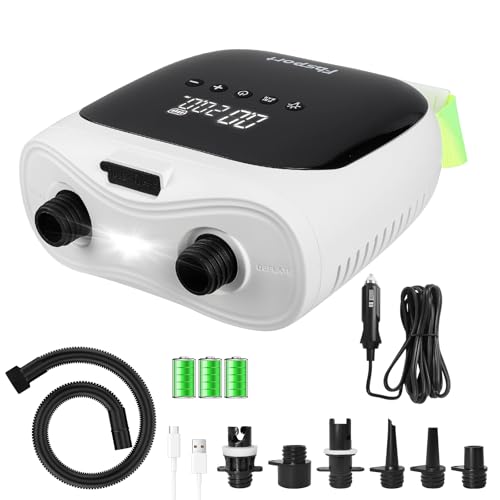
FBSPORT Rechargeable 20 PSI Paddle Board Pump, LCD Display, 6 Adapters

Lazyshine 45 PSI Dual-Powered Paddle Board Pump with 12000mAh Battery and Auto-Off

ETENWOLF P300 Plus Electric Ball Pump

ETENWOLF Electric Ball Pump with 2600mAh Battery

Seesii Cordless Paddle Board Electric Pump 20 PSI

TOPUMP Cordless Rechargeable Paddle Board Pump

OGERY Dual-Power Paddle Board Pump, 20 PSI Auto-Off
Why These Options Stand Out
Unpacking a board beside the car becomes much easier when the pump draws continuous power from a 12-volt direct-current socket. Unlike the rechargeable models later in this list, the Kleholti has no built-in battery, so the 3-meter cable provides useful reach around a tailgate or open vehicle area. That makes it a natural fit for paddlers who always launch from their car and prioritize quick, uncomplicated inflation.
Its dual-stage system moves from 360 liters per minute of airflow to a 100-liter-per-minute high-pressure stage. A stated 20 PSI ceiling, auto shutoff, and pressure display make the process controlled, while seven nozzles cover common SUP valves, kayaks, tents, and pool inflatables. For most vehicle-based outings, the honest advantage is dependable power without a charging routine.
What Makes Sense
- Dual-stage inflation prioritizes airflow before pressure, which shortens the initial fill.
- Preset pressure and automatic shutoff reduce the need to watch the display continuously.
- The vehicle connection eliminates battery charging between lake trips.
- Seven nozzles make the pump useful for more than a single paddle board.
Practical Considerations
- The pump must remain connected to a 12-volt vehicle socket and has no built-in battery.
- The 20 PSI limit makes a pressure check before inflation essential for specialized inflatables.
At A Glance
Made For
Car-based paddlers who want a long cable, quick fill, and reliable vehicle power at a familiar launch site.
Where Another Pick Suits Better
The TOPUMP Cordless Rechargeable Paddle Board Pump better suits paddlers who need to inflate away from their vehicle.
Rechargeable power makes the FBSPORT a more flexible alternative to the Kleholti, especially for campsite launches and beach days where the car may be some distance away. Its 4,000 mAh battery, meaning milliamp-hours of electrical capacity, is stated to handle as many as three paddle boards per charge. A vehicle cord adds another way to replenish it, so a missed charge does not necessarily end your outing.
The LCD screen displays live pressure and accepts a target setting that triggers automatic shutoff. Inflation and deflation take roughly 10 to 15 minutes for compatible gear, while button controls can add pressure in 0.5 PSI increments. At 4.2 pounds and 7.5 by 6.9 by 3 inches, it fits in a backpack, although it is not the lightest model here.
Good Reasons To Consider
- Rechargeable operation removes the need to remain beside a vehicle.
- The included vehicle cord provides a practical backup power route.
- Six adapters cover boards, tents, mattresses, pools, and other inflatables.
Things To Consider
- The 20 PSI ceiling falls short of the broader pressure range offered by the Lazyshine model.
Quick Facts
Right Fit For
Weekend campers and travelers who want cordless inflation plus the reassurance of vehicle power nearby.
Consider Something Else When
The OGERY Dual-Power Paddle Board Pump may suit you better when rapid dual-stage inflation is the priority.
The Lazyshine expands beyond the 20 PSI limit shared by most paddle board pumps in this group. Dual motors, a 45 PSI ceiling, and a 12,000 mAh battery give it greater scope for inflatable boats, car tires, and other equipment that may need more pressure than a standard SUP. That extra capability is meaningful for households with a mixed collection of inflatable gear.
Unlike the more compact FBSPORT, this model also accepts 12-volt vehicle power. A digital display handles preset and live pressure readings, with auto shutoff ending the cycle at your target. The 3.2-pound housing includes a handle, LED light, USB output, and several nozzles, so it can handle a campsite evening or provide a small device charge between uses.
Strengths Worth Knowing
- Two motors support faster inflation and deflation across a wide range of inflatables.
- The 45 PSI maximum provides more headroom than conventional 20 PSI models.
- Battery and vehicle power suit both remote camps and roadside preparation.
- USB output adds a practical function beyond inflation.
- Multiple nozzles accommodate boards, boats, mattresses, and car tires.
Possible Compromises
- The broad pressure capability can be more than many paddle board owners need.
- Its 3.2-pound weight remains substantial for backpacking, even though it is lighter than the FBSPORT.
- Check each nozzle before using it with car tires or other non-SUP equipment.
Technical Highlights
Built With In Mind
Outdoor households that inflate SUPs alongside boats, tires, mattresses, and other high-pressure equipment.
A Better Fit Elsewhere
The FBSPORT Rechargeable 20 PSI Paddle Board Pump is the lighter option for trips centered only on boards and camping gear.
The ETENWOLF P300 Plus marks a change in equipment: it is built for sports balls rather than paddle boards. Basketball players can bring it to the driveway, gym, or outdoor court without relying on a wall outlet or a hand pump. Its 3,200 mAh rechargeable battery makes repeated ball preparation more convenient, especially during a family game or practice session.
Pressing a button starts automatic inflation toward the selected pressure, with the stated completion time around one minute. That figure will naturally vary with the ball’s starting pressure and size, but the pressure-based approach is more useful than simply running a continuous airflow. The unit also has a 2600 mAh version, giving the P300 Plus the larger stated battery of the two ETENWOLF models.
Why It Works Well
- Automatic pressure selection simplifies repeated ball preparation.
- The rechargeable 3,200 mAh battery supports cordless use at the court or gym.
Where It May Fall Short
- Its ball-focused design does not cover SUP, tent, or kayak inflation.
- The one-minute result depends on the ball type and how much air it initially needs.
Who Should Grab It
Basketball players and families who want quick, cordless inflation for several sports balls.
Another Choice May Suit
The ETENWOLF Electric Ball Pump with 2600mAh Battery is the more compact alternative for basic ball maintenance.
Compared with the P300 Plus, this ETENWOLF model keeps the focus narrow: fast, cordless inflation for sports balls. A 2,600 mAh rechargeable battery removes the need to find an outlet before practice, while automatic pressure adjustment reduces the guesswork involved in bringing a basketball or similar ball up to its intended firmness.
The stated one-minute inflation time makes the pump practical for games where balls lose pressure between uses. It also supports deflation, so storage does not require a separate manual step. Your use case determines the appeal: for someone who regularly handles several balls, the convenience is more useful than carrying a full-size inflatable pump.
Features That Help
- Automatic inflation and deflation provide a complete ball-maintenance routine.
- The rechargeable battery supports use at indoor and outdoor courts without a nearby outlet.
Small Caveats
- It is limited to sports-ball use rather than large water-sports inflatables.
- Its 2,600 mAh capacity is smaller than the P300 Plus’s stated 3,200 mAh battery.
- Actual inflation time varies with ball size and its starting pressure.
Best Suited To
Home users, recreational players, and coaches who mainly need dependable ball inflation.
Look Elsewhere When
The ETENWOLF P300 Plus Electric Ball Pump may suit you better for more frequent basketball preparation.
The Seesii keeps the central idea simple: recharge the pump, carry it to the water, and inflate without waiting beside a vehicle. That cordless freedom makes it useful for lakeside camps, remote launches, and travel days where vehicle access may be inconvenient. It is designed for SUPs, kayaks, and inflatable boats rather than being limited to a single board type.
Its 20 PSI maximum gives it the same stated ceiling as several larger models, including the FBSPORT, without requiring a vehicle connection during use. Compared with the Lazyshine, however, it offers a narrower pressure range and no stated tire or high-pressure equipment function. The cleaner fit is therefore for paddlers whose equipment stays within that 20 PSI envelope.
Real-World Strengths
- True cordless operation supports launches away from a vehicle.
- Twenty PSI is suitable for many high-pressure SUP, kayak, and boat applications.
- One pump can cover several major categories of water-sports inflatables.
- Its focused purpose keeps packing decisions uncomplicated.
A Few Limitations
- Verify that your board or boat does not require pressure above the stated 20 PSI limit.
Feature Snapshot
Who Will Love This
Paddlers who value cordless freedom and use SUPs, kayaks, or boats within a 20 PSI range.
Reach For A Different Pick When
The Lazyshine 45 PSI Dual-Powered Paddle Board Pump better serves people inflating high-pressure boats or car tires.
Carrying less gear matters when the path to the launch includes stairs, a narrow beach entrance, or a crowded parking area. The TOPUMP weighs 1.1 kilograms, or roughly 2.4 pounds, making it the lightest option with a stated weight in this group. That compact profile suits paddlers who split the load among several people or keep their equipment in a small vehicle.
Its rechargeable battery is stated to inflate three 10.6-foot boards to 12 PSI per charge. That is a meaningful capacity for weekend trips, though larger board volumes or different pressure targets can change runtime. You can inflate away from a car outlet, which provides more freedom than the Kleholti’s continuous vehicle-powered arrangement.
The Case For It
- The 1.1-kilogram weight keeps it manageable in a gear bag.
- Cordless operation removes dependence on a nearby car socket.
- One charge is stated to cover three 10.6-foot SUPs at 12 PSI.
Things That May Matter
- Runtime varies with board volume and the pressure selected.
- Its lighter design may offer less room for extra functions than the Lazyshine model.
The Right Fit
Travel-focused paddlers who prioritize low weight and cordless use over multi-purpose inflation.
Swap It Out When
The FBSPORT Rechargeable 20 PSI Paddle Board Pump better suits you when lighting and device charging are priorities.
The OGERY combines rechargeable freedom with 12-volt vehicle power, placing it between the continuous-power Kleholti and the strictly cordless options. Dual-stage inflation is designed to move from high airflow to a controlled high-pressure stage. The stated results are about five minutes for a standard board at 12 PSI and six and a half minutes at 15 PSI, giving you a useful estimate before a busy launch area becomes crowded.
Its 20 PSI ceiling and automatic shutoff make it appropriate for high-pressure paddle boards while limiting the need to watch the pump closely. That balance is less specialized than the 45 PSI Lazyshine and more thoughtfully structured for frequent weekend use. You still need to confirm that your board’s valve and pressure requirement match the pump’s setup.
The Upside
- Dual power supports both remote launches and roadside preparation.
- Two-stage inflation gives the initial fill and final pressure separate jobs.
- Automatic shutoff provides a clear endpoint for the selected pressure.
- Stated fill times make planning around launch day more predictable.
Possible Compromises
- Its 20 PSI maximum is lower than the Lazyshine’s stated ceiling.
- Carrying both a rechargeable battery and vehicle option means maintaining two power paths.
- Actual fill time depends on board size and starting pressure.
Core Details
Whose Shelf It Belongs On
Weekend paddlers who want cordless flexibility, vehicle backup, and quick inflation.
Where A Sibling Pick Shines
The TOPUMP Cordless Rechargeable Paddle Board Pump better fits travelers who prioritize minimum carried weight.
What Matters Before You Pack the Pump
Power Where You Need It
Cordless power offers the most freedom at remote launches, while vehicle power removes charging from your preparation routine. Dual-power models offer a middle path, though you must keep both the battery and vehicle connection in working order. Your usual launch location matters more than the power specification printed on the box.
Pressure and Inflation Design
PSI means pounds per square inch, and it describes the air pressure inside an inflatable rather than its airflow. A pump with multiple stages uses high flow for the large initial volume and lower flow for final pressure, which is helpful for rigid SUP valves. Confirm your board’s required pressure before selecting a 20 PSI or 45 PSI model.
Valve Fit and Versatility
The correct nozzle can matter as much as the motor. SUP pumps commonly include dedicated valve fittings, while multi-purpose models add attachments for kayaks, tents, air mattresses, boats, and pool inflatables. Check the included adapters against your equipment rather than assuming every inflatable uses the same connection.
Practical Decisions Before Launch Day
Mistakes Worth Dodging
Avoid choosing solely by battery capacity, since pressure, airflow, and valve compatibility affect the actual task. Also check the pump’s physical size against your vehicle or gear bag, particularly when the path to the water is long. A model that suits the board but is awkward to carry can still slow down launch day.
What The Higher Tier Buys
Higher-capacity models often add stronger motors, broader pressure ranges, larger batteries, or dual power. Those features help when you inflate several boards, use varied equipment, or travel without frequent access to a vehicle. For a single-board paddler with a nearby outlet, the added capability may remain unused.
Frequently Asked Questions
Can a Battery Powered SUP Pump Reach 20 PSI?
Yes, several models in this list have a stated 20 PSI maximum. Always check your board’s required pressure and select the correct valve fitting before inflating.
Do I Need a Car Socket to Use These Pumps?
No, several models use rechargeable batteries, and dual-power options add vehicle charging. The Kleholti is the exception because it requires a continuous 12-volt vehicle connection.
Which Pump Is Best for High-Pressure Inflatables?
The Lazyshine model has the highest stated ceiling at 45 PSI and includes fittings for boats and car tires. It suits users who need more pressure than a standard 20 PSI paddle board pump provides.
What Does Dual-Stage Inflation Mean?
Dual-stage inflation uses high airflow to add volume quickly, then reduces airflow for the final pressure stage. This approach can shorten inflation while giving the valve a more controlled top-off.
Which Model Is the Most Portable?
Among the models with stated weights, the TOPUMP is the lightest at 1.1 kilograms. The FBSPORT weighs 4.2 pounds, while the Lazyshine weighs 3.2 pounds, but carrying size and storage also influence portability.
Final Thoughts
The right battery powered SUP pump depends on where you inflate and what you carry. Cordless models suit remote launches, vehicle-powered options simplify preparation, and multi-purpose pumps handle more than a single board. Match the pressure range, nozzle, and carried size to your normal routine, and your launch day will feel considerably easier.