
A bathroom water filter can turn an ordinary sink into a convenient source of better-tasting drinking water, which is useful for a busy household, a compact apartment, or a shared guest bath. The systems below use under-sink reverse osmosis, a process that pushes water through a semipermeable membrane to reduce dissolved contaminants.
Your closest match comes down to capacity, alkaline filtration, ultraviolet treatment, and the number of included filter stages. These systems serve sinks rather than showers, so they suit filtered water needs, not whole-home softening or water-pressure correction.
The Lineup, Simplified

APEC ROES-UV75 6-Stage RO System

APEC ROES-50 5-Stage RO System
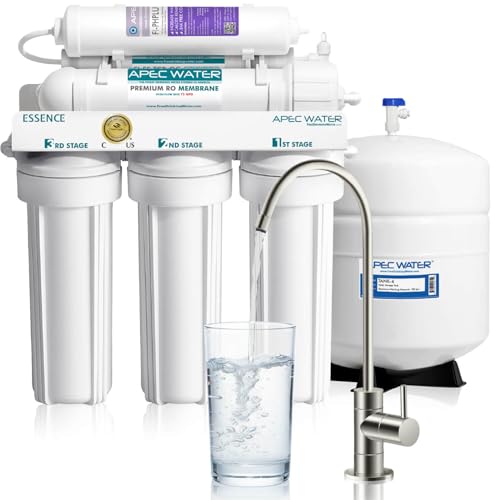
APEC ROES-PH75 6-Stage Alkaline RO

APEC ROES-50X 5-Stage RO, 50 GPD

APEC Water ROES-PHUV75 7-Stage Under Sink RO System, Alkaline & UV, 75 GPD

APEC RO-90 5-Stage Under Sink RO

APEC Water ROES-PH75X 6-Stage Under Sink RO System, Alkaline, Extra Filters, 75 GPD
The Strengths Of Each Pick
Filtered water at a bathroom sink becomes more useful with the ROES-UV75’s combination of six reverse-osmosis stages and ultraviolet treatment. Its stated 75-gallons-per-day capacity exceeds the 50-GPD models in the lineup, while the UV stage adds an extra treatment step for tap or well water.
For a family that drinks and prepares food with filtered water, this appears to be the most complete straightforward package. The included faucet, JG tubing, illustrated instructions, and installation videos help make an under-sink setup less intimidating.
Benefits That Matter
- Six stages combine reverse osmosis with ultraviolet treatment.
- A stated 75-GPD output suits moderately busy household use.
- The manufacturer reports up to 99% removal of numerous listed impurities.
- Lead-free faucet construction and JG tubing complete the installation package.
- Printed guidance and online videos support DIY setup.
Trade Offs
- The UV assembly and six-stage layout require adequate cabinet space and compatible plumbing.
Technical Sheet
Who It Suits Best
This model best fits households that want 75-GPD capacity and UV treatment at a dedicated drinking-water sink.
A Better Fit Elsewhere
The APEC ROES-50 serves lighter use more economically through a simpler five-stage design without UV.
The ROES-50 keeps the focus on five-stage reverse-osmosis filtration and a stated 50-gallons-per-day output. That simpler configuration suits a couple, an apartment, or a second drinking-water sink where continuous UV treatment and 75-GPD capacity are unnecessary.
The manufacturer lists around-the-clock support and coverage options for accidental damage and breakdowns, with plan details varying. A five-stage layout also offers a more restrained path to filtered drinking water than the seven-stage ROES-PHUV75.
The Case For It
- The five-stage design covers core reverse-osmosis filtration without a UV assembly.
- Listed support includes assistance for accidents and breakdowns, subject to the applicable plan.
Worth Noting
- Its 50-GPD capacity is lower than the 75-GPD and 90-GPD alternatives.
- No UV stage appears in the five-stage configuration.
- Under-sink cabinet space and a suitable connection point still need to be available.
Quick Facts
Made For
Smaller households gain a practical balance of five-stage filtration, 50-GPD output, and straightforward installation.
Look Elsewhere When
The APEC RO-90 fits households that need the lineup’s highest stated daily capacity.
Six stages, alkaline configuration, and a stated 75-GPD output make the ROES-PH75 a middle path between the simpler APEC ROES-50 and the feature-heavy ROES-PHUV75. It offers more capacity than the 50-GPD models without adding the UV stage.
That balance feels useful in a shared home where drinking and cooking demand steady filtered water. The listed maximum total dissolved solids feed level of 2,000 ppm also provides a concrete input-water consideration for your installation.
The Helpful Details
- Six-stage reverse osmosis provides a broader sequence than the five-stage models.
- Alkaline configuration gives this model a distinct water profile.
- The 75-GPD rating provides more stated capacity than the ROES-50 and ROES-50X.
- Up to 99% reduction is claimed for the listed contaminants.
Points To Note
- UV treatment is absent compared with the ROES-UV75 and ROES-PHUV75.
- The cabinet must accommodate six stages and the under-sink plumbing.
Right Fit For
This model suits households wanting alkaline reverse osmosis and 75-GPD output without a UV assembly.
Another Choice May Suit
The APEC ROES-PHUV75 better serves users who also want UV treatment and seven-stage filtration.
The ROES-50X gives you the familiar five-stage ROES-50 foundation with a larger collection of replacement filters. It remains a 50-GPD under-sink system, so the main appeal is easier filter availability and added serviceability rather than greater flow.
For a couple or a lower-use bathroom sink, that combination may be more sensible than paying for UV or alkaline stages you will not use. The manufacturer reports reduction of chlorine, lead, fluoride, arsenic, heavy metals, and more than 1,000 listed impurities.
What Helps Most
- Extra filters make cartridge replacement planning easier.
- Five-stage reverse osmosis keeps the filtration path understandable.
- The 50-GPD output suits moderate use without claiming the RO-90’s higher capacity.
Minor Gripes
- The extra filter set adds components that require cabinet space.
Feature Breakdown
Who Will Love This
This system appeals to households that want extra replacement filters but do not require UV treatment.
Consider Something Else When
The APEC ROES-PH75 fits users who prioritize 75-GPD capacity and alkaline treatment over extra 50-GPD replacement filters.
The ROES-PHUV75 combines every major treatment theme in the lineup: seven stages, alkaline configuration, UV treatment, and a stated 75-GPD output. It is the natural choice for a user who does not want to choose between alkaline water and an added microbial-treatment step.
Compared with the ROES-PH75, it adds UV and another filtration stage. Its listed NSF/ANSI 372 and 58 standards also provide a more structured way to evaluate specific material and contaminant-reduction claims.
Practical Pluses
- Seven stages create the most comprehensive sequence in the group.
- UV adds a treatment step absent from the alkaline ROES-PH75.
- The alkaline profile and 75-GPD output serve everyday drinking and food preparation.
- Tap water and well water are both named as suitable applications.
- Standards 372 and 58 are listed for the system’s performance claims.
Practical Considerations
- Seven stages and the UV assembly require careful cabinet planning.
- UV operation requires an electrical connection near the installed system.
- The listed standards apply to defined claims rather than every possible contaminant.
Built With In Mind
Households wanting alkaline reverse osmosis, UV treatment, and 75-GPD capacity find their most complete option here.
Reach For A Different Pick When
The APEC RO-90 better serves high-output households that can manage without alkaline or UV stages.
The RO-90 concentrates on one clear advantage: 90 gallons per day, the highest stated output among these systems. Its five-stage reverse-osmosis design remains straightforward, which makes it easier to consider for a home that wants more drinking and cooking water without alkaline or UV treatment.
That output can be sensible in a busy household, though 90 GPD may be more than a small apartment needs. The five-stage layout also gives it a cleaner feature profile than the seven-stage ROES-PHUV75.
A Few Highlights
- Its 90-GPD rating leads the lineup for stated daily production.
- Five-stage reverse osmosis keeps the system focused on core filtration tasks.
Points To Keep In Mind
- Its higher output may exceed the needs of a couple or small apartment.
- It lacks the alkaline and UV features found in the ROES-PHUV75.
Core Details
Whose Shelf It Belongs On
Busy households that drink and cook with filtered water benefit most from the 90-GPD capacity.
Skip It When
The APEC ROES-50 fits lower-use homes that do not need the RO-90’s additional stated output.
The ROES-PH75X combines alkaline reverse osmosis, 75-GPD output, and an expanded set of first-stage pre-filters. That pre-filter package is intended to handle incoming chlorine, fluoride, arsenic, and heavy metals before the later filtration stages.
It is a practical middle ground for shared homes that value extra pre-filter stock and alkaline water but do not need a UV assembly. The stated NSF/ANSI 372 and 58 standards add a clearer framework for evaluating applicable material and contaminant-reduction claims.
What Makes Sense
- Six alkaline reverse-osmosis stages provide a balanced treatment sequence.
- The expanded stage 1-3 pre-filter set improves replacement planning.
- A 75-GPD rating suits moderately busy households.
- Standards 372 and 58 are listed for relevant performance claims.
Things To Weigh
- The larger filter package takes more cabinet space than a basic five-stage setup.
Essential Details
The Right Fit
Households wanting alkaline water, 75-GPD capacity, and expanded pre-filter stock find a well-balanced match.
Swap It Out When
The APEC ROES-PHUV75 fits users who need an added UV stage and seven-stage filtration.
What Matters Before You Choose
Capacity should match actual daily demand
Gallons per day, abbreviated GPD, indicates a system’s stated daily production rate. The 50-GPD models suit lighter use, while 75 and 90 GPD provide more room for drinking, cooking, and frequent sink use.
Treatment stages answer different needs
A basic five-stage system focuses on reverse-osmosis filtration. Six- and seven-stage models may add alkaline treatment, UV treatment, or expanded pre-filters, so choose the feature that reflects your water concerns rather than counting stages alone.
Cabinet space affects the installation
Every option requires under-sink equipment, a dedicated faucet, and space for tubing. Models with extra cartridges, alkaline components, or UV hardware need a little more planning than the simplest configuration.
Input water and installation details matter
Check your available connection, faucet location, and electrical access before ordering. The listed maximum total dissolved solids figure on the ROES-PH75 also gives you a concrete input-water reference.
Where The Added Features Make The Difference
Pitfalls Shoppers Hit
The main mistake is choosing by stage count alone. A larger system may include components your water and household do not need, while a smaller model may lack the capacity you actually use. Measure the cabinet, locate the plumbing, and compare daily demand before deciding.
The Upgrade Payoff
Higher-tier models add UV treatment, alkaline configuration, or more pre-filters. Those additions earn their place when you have a specific reason to include them or value having extra replacement cartridges ready for regular servicing.
Frequently Asked Questions
Are under-sink RO systems suitable for a bathroom sink?
Yes, an under-sink reverse-osmosis system can provide filtered drinking water at a bathroom basin. It addresses water at that sink rather than treating shower water or softening water throughout the house.
What does 75 GPD mean?
Seventy-five gallons per day is the system’s stated daily production rate. It indicates its intended usage scale, but household needs vary with the number of people and how often the filtered faucet is used.
What is the difference between alkaline and UV models?
Alkaline models include a post-treatment stage intended to produce water with a more alkaline profile. UV models use ultraviolet light as an additional treatment step for microorganisms.
Does reverse osmosis remove chlorine and heavy metals?
The listed models state reduction of chlorine, lead, arsenic, fluoride, heavy metals, and numerous other impurities. Actual performance depends on the system, feed-water conditions, maintenance, and the specific contaminant involved.
Are extra replacement filters useful?
Extra filters make cartridge changes more convenient and can help maintain a consistent service schedule. They also require additional storage and cabinet space, which is worth checking before selecting a larger filter package.
Final Verdict
The APEC ROES-UV75 suits households wanting a strong balance of 75-GPD capacity and UV treatment, while the ROES-50 offers a simpler five-stage approach. For alkaline water with expanded pre-filters, the ROES-PH75X makes sense, and the RO-90 serves higher-output demand. Choose the configuration that fits your sink space, daily use, and treatment priorities rather than paying for features you will not use.