
A bedside alarm clock should be easy to read, easy to set, and difficult to ignore. I focus on compact options for small bedrooms, shared nightstands, travel, and homes where a phone screen adds clutter rather than convenience. The strongest choices here serve different routines, from a pocket-sized analog clock to a talking model and a sleep-focused bedside system.
The Lineup, Simplified

Lamisola 3.5-Inch Black Clock

memo24 Talking Button Alarm Clock for Blind and Visually Impaired

Miowachi Ceiling Projection Clock

Hatch Sleep Clock, Cocoa

Hatch Sleep Clock, Greige
Hatch Sleep Clock, Putty
The Details Behind The Selections
A clock that occupies less than four inches of bedside space is useful when the nightstand is crowded with a lamp, phone, and water glass. The Lamisola 3.5-Inch Black Clock uses a compact analog format, battery operation, and a retro metal body that suits a bedroom, office, or travel bag. Nothing about the styling is flashy, which is precisely why it fits a small room without adding visual clutter.
I favor this model for people who want a conventional face and hands rather than another glowing screen. Its 3.5-inch size may be less readable from across a large room, but it makes sense beside the pillow, where a close glance is the normal routine. The Lamisola model also has a night light, which adds a low-distraction way to check the time in darkness.
Positive Takeaways
- The 3.5-inch body saves meaningful space on a crowded nightstand.
- Battery operation keeps the clock usable without a nearby outlet.
- Silent operation avoids the familiar ticking sound that can disturb light sleepers.
- The night light provides a subtle view in a dark room.
- The retro metal construction adds character without demanding attention.
Small Caveats
- The small dial is best suited to bedside viewing rather than reading across a room.
- Battery replacement is a periodic ownership task that requires no outlet.
Made For
This clock suits people with limited nightstand space who prefer a traditional analog display and a restrained retro appearance.
Where Another Pick Suits Better
The Miowachi Ceiling Projection Clock offers a better fit for people who need a larger time display or a more forceful alarm.
Reading a small clock can become unreliable as vision changes, and the memo24 model removes that dependency by speaking the time and date. A large button provides a direct way to request the information, while a clear English male voice makes the output easy to identify. That design is more useful than adding another visual feature to a bedside table.
I would place this clock in the home of someone who benefits from spoken time checks, including an older adult with limited vision or a person who finds a conventional dial difficult to interpret. The two-volume setting also allows the spoken output to be adjusted for different rooms and hearing environments. Compared with the Lamisola 3.5-Inch Black Clock, this model prioritizes audible information over a traditional display.
What It Does Well
- A single press announces the current time, reducing dependence on a visual display.
- A second press provides the weekday and date information.
- The large button is easier to operate than several small controls.
- Two volume positions accommodate different listening needs.
Points To Note
- The spoken information is in English, making it less suitable for households that require another language.
- Battery operation requires periodic battery attention for continued use.
Built With In Mind
This model is designed for people with low vision or difficulty reading a conventional clock face, especially at bedtime.
Another Choice May Suit
The Lamisola 3.5-Inch Black Clock better serves people who want a visual display and prefer traditional clock hands.
A ceiling projection gives the time a different visual position, high above the bed where a person can read it without reaching for a bedside device. The Miowachi Ceiling Projection Clock uses an ice-crystal-blue display, four brightness levels, and a lens that rotates through 180 degrees. The projection can be directed across a wall or onto the ceiling from 5 to 16.4 feet away.
This arrangement works well in a dark bedroom, especially for someone who wants to check the hour without opening one eye. The alarm offers five volume levels ranging from 55 to 95 decibels, giving light sleepers a gentler setting and heavy sleepers a more noticeable option. It rings for up to two minutes, with snooze and other-key dismissal available for added control.
Real Benefits
- The projected time is visible without picking up a phone or leaning over the clock.
- Four brightness settings accommodate different levels of ambient darkness.
- The rotatable lens supports wall and ceiling placement.
- Five alarm levels offer a broader range than a single-volume control.
- Snooze and key-based stopping reduce the need to locate a tiny control.
Practical Considerations
- The clock must be positioned within its stated 5-to-16.4-foot projection range.
- The illuminated ceiling display may be distracting in a very dark room at the wrong brightness level.
Right Fit For
This model suits dark bedrooms, shared sleeping spaces, and people who benefit from an alarm with multiple audible levels.
Where A Sibling Pick Shines
The Hatch Sleep Clock, Cocoa is a stronger fit for people who want a broader bedtime routine built around light, sound, and sleep tracking.
The Cocoa edition turns the bedside clock into a sleep routine device rather than a simple time display. Hatch combines sleep tracking, a smart light, and a sound machine in one unit, with a sunrise alarm that uses gradual illumination as part of the wake-up routine. Full-spectrum LED light supports different settings, while selectable sounds include white, pink, and brown noise for a consistent bedtime atmosphere.
I would consider this model for a bedroom where winding down matters as much as waking on time. Three sleep-tracking modes offer different levels of routine analysis, and cable management helps keep the bedside area orderly. The honest read is that this is a broader sleep device than a conventional alarm clock, so it fits best for someone who values the surrounding bedtime features as much as the alarm itself.
Useful Highlights
- The sunrise alarm creates a gradual transition from sleep to waking.
- White, pink, and brown noise provide several familiar sound options.
- Full-spectrum LED light supports multiple bedside lighting routines.
- Three sleep-tracking modes add useful context to nightly rest patterns.
- Cable management reduces the loose-device clutter common on a nightstand.
Possible Compromises
- The broader feature set requires more bedside space than the Lamisola 3.5-Inch Black Clock.
- Sleep tracking is a secondary benefit for anyone who only needs a basic alarm.
Who Will Love This
This edition suits people who want one bedside device for sleep tracking, soothing sound, light, and a gradual morning alarm.
Reach For A Different Pick When
The Miowachi Ceiling Projection Clock offers a more focused fit for people whose main requirements are a large time display and adjustable alarm volume.
The Greige finish gives the Hatch Sleep Clock a quieter presence in a bedroom where dark electronics would feel visually heavy. Its function reaches well beyond an alarm: the device tracks sleep, operates as a smart light, and produces soothing sound through white, pink, and brown noise options. A sunrise alarm adds gradual illumination to the wake-up period.
I recommend this color for neutral, coordinated interiors, particularly a guest room or primary bedroom with pale bedding and warm wood furniture. Full-spectrum LED light and three sleep-tracking modes make the device more useful across the night, while cable management keeps its charging setup orderly. Compared with the Cocoa edition, the core functions remain the same, so the decision comes down to which finish blends more naturally with the room.
Notable Upsides
- The Greige finish sits comfortably beside neutral bedding and wood furnishings.
- The sunrise alarm offers a gentler lighting-based wake-up routine.
- Three sound options support different preferences for bedtime noise.
- Three sleep-tracking modes provide more information than a basic display.
Details To Watch
- The bedside footprint is larger than a compact analog clock.
- The full feature set may be excessive for a guest room with minimal overnight use.
- The neutral finish has little visual effect on the underlying functions.
The Right Fit
This version fits people with neutral bedroom decor who want a multi-function bedside system rather than a basic clock.
Swap It Out When
The Hatch Sleep Clock, Putty is a more suitable choice for a room with warmer beige or stone-toned furnishings.
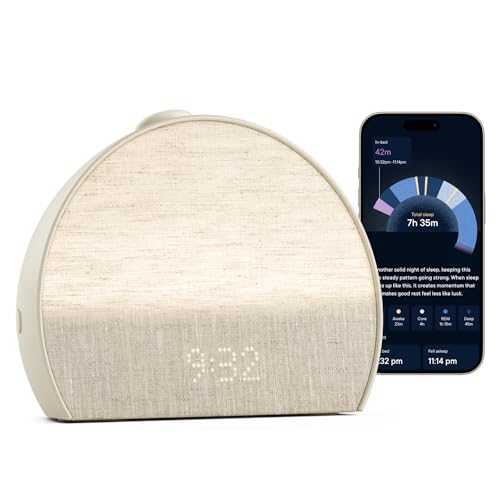
A small apartment often has less room for separate night lamps, sound machines, and sleep-tracking gadgets. The Putty edition combines those functions in one bedside unit, reducing the number of objects competing for table space. Its smart light offers full-spectrum LED settings, while the sound machine supplies white, pink, and brown noise for a consistent bedtime background.
I see this finish as useful in compact rooms where a cooler white or black device would look visually stark against warm walls. The sunrise alarm brings in gradual light, three sleep-tracking modes add information about nightly routines, and cable management helps preserve the limited surface area. The memo24 Talking Button Alarm Clock offers a lighter alternative when spoken time checks matter more than sleep tracking.
Real-World Strengths
- Combining light, sound, tracking, and an alarm reduces bedside device clutter.
- The warm Putty finish blends with beige, cream, and natural wood interiors.
- The sunrise alarm creates a gradual transition into the morning.
- Three noise options give the sound function useful variation.
- Three sleep-tracking modes suit a more complete bedtime routine.
Less Ideal Details
- The multi-function body still requires more room than a 3.5-inch analog clock.
- Tracking data has limited relevance for someone who only wants a time display.
Whose Shelf It Belongs On
This model suits apartment residents and couples who want a coordinated bedside setup with fewer separate devices.
Consider Something Else When
The Lamisola 3.5-Inch Black Clock is the clearer fit for travelers and anyone who prioritizes minimal size over sleep features.
What Matters Most Before Buying a Simple Alarm Clock
Reading distance and placement
A compact analog clock works well close to the pillow but can become difficult to interpret from across a bedroom. A projection model solves that visibility problem at the cost of requiring more deliberate positioning. I compare the intended viewing distance before deciding which format fits a particular nightstand.
Audio and accessibility needs
Alarm volume matters more to some sleep routines than display design. The memo24 model goes further by announcing the time and date through a large button, while the Miowachi clock emphasizes louder, adjustable alarm levels. Hearing needs and language preferences should guide this choice more than appearance alone.
Bedroom routine and available space
A basic time display remains the least demanding option for a small nightstand. The Hatch models earn their larger footprint through sleep tracking, lighting, sound, and gradual morning illumination. For compact homes, that consolidation can be worthwhile, but a crowded table may call for the Lamisola 3.5-Inch Black Clock instead.
Two Details That Shape the Choice
Common Shopping Slip Ups
A small clock can be attractive yet difficult to read from a typical sleeping position. Projection models can also be placed beyond their useful range, producing a faint or poorly aimed image. I check dial size, viewing distance, and bedside space together rather than judging only by appearance.
What Separates Premium From Basic
A premium sleep device adds light, sound, tracking, and routine controls rather than merely improving the time display. That expansion makes sense for a bedroom-centered routine, while a basic clock is more appropriate for minimalism and travel. The useful upgrade depends on how much of the bedside routine the device is expected to manage.
Frequently Asked Questions
What is the simplest alarm clock for a small nightstand?
The Lamisola 3.5-Inch Black Clock has the smallest stated footprint in this group and uses an analog display. It suits a crowded bedside table where space matters more than extra features.
Which alarm clock is easiest to check in the dark?
The Lamisola 3.5-Inch Black Clock includes a night light, while the Miowachi Ceiling Projection Clock projects a large blue time display. The latter is easier to read from farther away, though it requires proper placement.
Is a talking alarm clock useful for daily time checks?
The memo24 Talking Button Alarm Clock provides spoken time, weekday, and date information through a large button. It is particularly useful for people who have difficulty reading a small clock face.
Are projection alarm clocks suitable for heavy sleepers?
The Miowachi Ceiling Projection Clock includes five alarm volume levels ranging from 55 to 95 decibels. The multiple settings provide greater flexibility than a single-volume alarm.
Should I choose a sleep-tracking clock instead of a basic alarm?
A sleep-tracking clock makes sense when light, sound, and sleep information form part of the nightly routine. A basic clock remains simpler and more compact for travel, guest rooms, or minimal bedside setups.
Final Verdict
The Lamisola 3.5-Inch Black Clock covers the basic need with the least bulk, while the memo24 Talking Button Alarm Clock serves visual accessibility. The Miowachi Ceiling Projection Clock prioritizes visibility and adjustable alarm volume, and the three Hatch editions add sleep tracking, soothing sound, and gradual lighting. The right choice comes down to bedside space, viewing needs, and the value of a broader sleep routine.